Bot Traffic Flags Are an Opt-Out Failure When They Cannot Name the AI Model or Its Operator
A bot flag without a named operator can't power opt-outs.
To detect AI agents on a website, a system must connect request logs, User-Agent matching, network verification and behavioral evidence to a named model or agent and its operator. A flag reading “unknown AI agent” establishes presence while leaving identity unresolved. Without that identity, the site cannot apply an operator-specific opt-out, assess compliance or reliably separate AI activity from human demand.
Why a bot traffic flag that cannot name the agent is not detection at all
An opt-out addressed to “unknown AI agent” is a note to no one. There is no identified operator whose policy can be consulted, whose infrastructure can be verified or whose conduct can be assessed. The flag may distinguish automation from a human visit, but it leaves the central operational question unanswered. Who is responsible for the request?
Detection and opt-out are distinct operations, even though they depend on some of the same information. The web’s robots.txt sets rules for automated visitors by matching agent names, but those visitors must recognize and follow the rules for them to work. A site can therefore detect automation without knowing which rule or operator policy applies. Presence detection is only the first step. Identity resolution supplies the connection between the traffic, the party operating it and the action the site intends to take.
What the User-Agent string actually is — and what it cannot do
The User-Agent string is an unverified, client-controlled HTTP header. Any scraper can label a request GPTBot, because the header itself does not establish that the request came from OpenAI’s infrastructure. A matching name is not a credential. Snowplow’s detection framework ranks User-Agent matching as the least reliable of its three methods because this identity signal is trivial to spoof.
Verification needs a separate check against IP ranges or other network evidence that the operator has published. Without that check, a rule keyed to GPTBot is responding to an unverified claim of operator identity. This distinction is decisive for opt-out enforcement, where the name is supposed to connect a request to a responsible party. The check also has a dependency. An operator must publish something against which the claimed identity can be tested.
Operators who publish nothing to verify against
If an operator publishes no IP ranges, reverse DNS conventions or network identifiers, there is no network reference from that operator to check against. Even a request with an honest label cannot pass a check when there is no reference data. This gap is structural. Better User-Agent matching cannot produce the missing evidence, and a plausible label cannot substitute for it.
The absence of a reference limits what a detection system can substantiate through that verification route. Network origin and behavior may still support a classification of automated traffic, but those signals do not automatically prove which operator sent it. Suspicion and attribution are different outputs. A system that collapses them into a confident operator label replaces an explicit unknown with an unsupported claim.
Publication also changes the verification position over time. Anthropic now publishes crawler IP ranges, so its traffic has a reference against which a claimed identity can be tested. Other operators may lack the same documentation, and those that lacked it before may have it now. Verification depends on current operator disclosures. The operational distinction is between traffic with a published verification path and traffic for which that path is unavailable.
Opt-out tokens that are not crawlers — and what that means for anyone who thinks they have opted out
A correctly spelled robots.txt entry may not name a crawler at all. Some entries are control tokens that express preferences without corresponding to an HTTP agent. They issue no requests. Consequently, they never appear as requesting agents in access logs and cannot themselves be blocked at a firewall or CDN.
Google states that Google-Extended is a robots.txt control token and that it does not affect Search inclusion or ranking. Adding it states a preference on training but does not stop a crawl. The administrative action is real, but it is not traffic blocking. Here, the site has a name without a requesting agent, reversing the situation in which a requesting agent lacks a verifiable name. A preference record and an access restriction are different controls.
Documented non-compliance even where identity is clear and robots.txt is correctly set
Cloudflare’s “Continuous accountability for Verified bots,” dated October 16, 2026, describes a trust-band and robots.txt accountability system under its BotBase model. The policy treats verification and conduct as separate concerns. Identity is necessary, but it is not sufficient. Cloudflare’s September 15, 2026 change started new default blocking of Training and Agent crawlers on ad-carrying pages, preceding the later accountability announcement.
Cloudflare documented Perplexity “repeatedly modifying their user agent and changing their source ASNs to hide their crawling activity, as well as ignoring — or sometimes failing to even fetch — robots.txt files.” It also stated that it “de-listed them as a verified bot.” Those findings show what the operator was seen doing in those cases, but they give no grounds to guess about every request tied to it. An accountability process needs both attribution and evidence of behavior.
The July 2026 AI Crawler Block Index found that a substantial share of sites declaring GPTBot bans still served GPTBot a live page despite their robots.txt disallow rules. That finding shows that sites failed to enforce their rules, but it does not prove that every such request broke an operator’s promise. User-initiated retrieval introduces another distinction. OpenAI states that robots.txt rules may not apply to ChatGPT-User actions because a user initiates them, while Anthropic states that disabling Claude-User prevents retrieval in response to a user query. Blocking a training crawler therefore does not necessarily exclude user-requested fetching, and an unknown identity prevents the site from determining which published policy applies.
What unidentified agent traffic does to analytics and attribution downstream
The naming gap is also a data quality failure. Sales and demand-generation teams need to tell human visits apart from automated retrieval, even when they are not concerned with robots.txt compliance. If unresolved automation enters the human-session stream, funnel and attribution metrics become less dependable. An automated request is not demonstrated buying interest. Treating the two alike obscures both the demand signal and the content consumption that AI systems represent.
GA4 automatically excludes known bots, and that exclusion cannot be turned off. Its known-bot treatment does not establish that every unidentified agent has been removed from the remaining traffic. A generic automation flag also does not, by itself, provide an operator-specific classification for downstream analysis. The denominator remains a practical concern. Match rates and conversion measures depend on which sessions the reporting system treats as human.
Siteimprove’s AI Traffic documentation distinguishes referral measurement from other AI activity. Its AI Referral Traffic classification uses referrer-domain matching, while server-side fetching and caching may register a crawler request. The documentation also notes that no universal parameter is applied automatically. Missing referrers, copied links and tools outside its reference list therefore limit attribution. A crawler fetching content, a human arriving through an AI referral and a browser agent navigating pages are distinct streams that the label “AI visit” groups together.
Snowplow’s framework favors detection over blocking because agents that are kept out can also be missed in the analysis. Every request may not have value, but understanding the traffic is a separate task from deciding whether to let it in. Without a way to sort that traffic, teams cannot reliably link the content AI systems read to the traffic those systems send back.
How can AI agents be detected on a website through genuine identity resolution?
Request logs establish the starting point for determining which agents requested which content. User-Agent matching shows who a request claims to be from, while IP ranges and DNS conventions that the operator publishes, where available, offer a separate way to check that claim. Neither step answers every question alone.
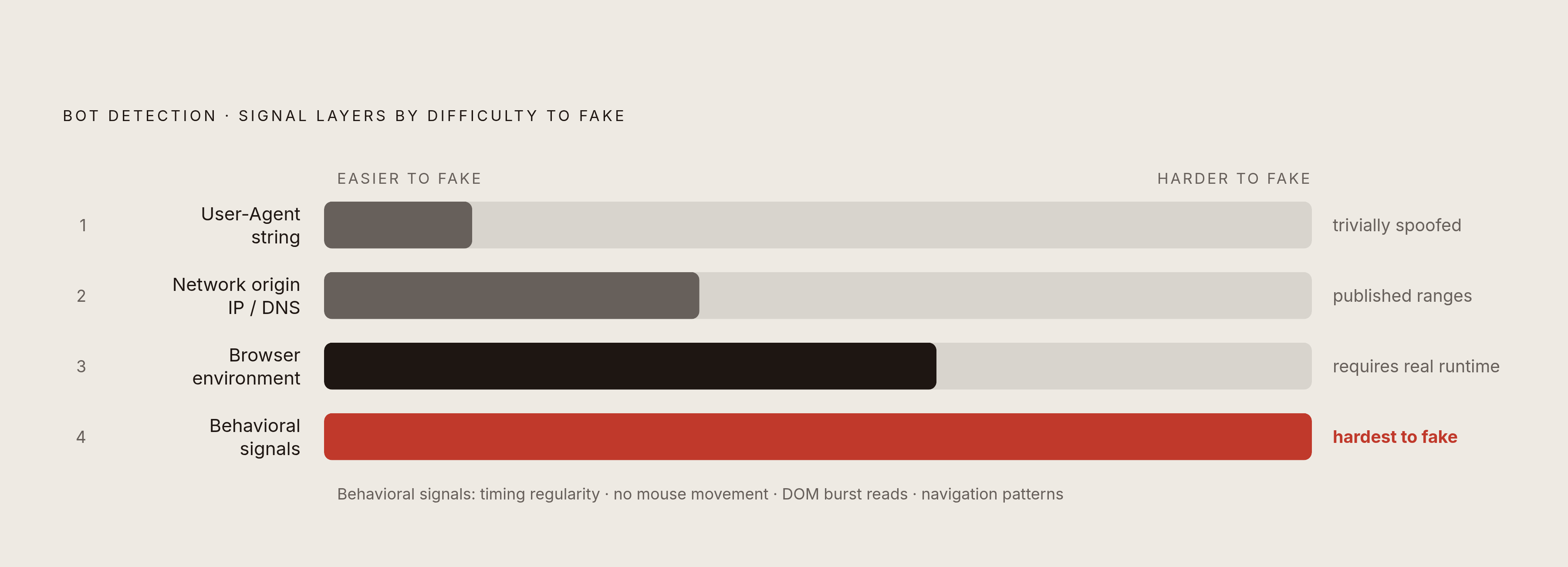
Snowplow ranks network origin above User-Agent identity signals because whether a request comes from a cloud-provider or residential-ISP is harder to fake than a header. It ranks behavioral signals as the hardest to fake, including navigation patterns, how regular the timing is, the absence of mouse movement and DOM burst reads. Those signals help sort traffic, but they do not name a model on their own. A composite approach scores identity, network, browser environment and behavior together. Its purpose is to catch agents that pass an individual check.
Operator documentation is a moving dependency in that process. Anthropic publishes IP ranges at claude.com/crawling/bots.json, while OpenAI’s documentation has moved to developers.openai.com and GPTBot is at version 1.4. OAI-SearchBot’s User-Agent now starts with a full Chrome desktop string, so filters that look for its older short form can miss it. Static matching rules can drift out of accuracy.
The IETF Web Bot Auth working group adopted “HTTP Message Signatures for automated traffic” as its first draft on September 1, 2026. It points toward a stronger basis for agent authentication, but it remains a draft and few agents have implemented it. It is not a solved identity layer. Today’s practical tools address different parts of the problem, with Cloudflare providing bot verification and enforcement, Snowplow describing layered detection, and Siteimprove classifying known AI referrals. Those complementary capabilities leave each tool’s ability to resolve every agent to a model and operator unproven.
What person-level identification of AI agents actually requires — and what tools can deliver today
Naming an operator does not identify the individual on whose behalf an agent acted, and naming a company does not identify a human visitor. Both distinctions are essential to visitor intelligence. A platform’s match rate is only interpretable when its reporting separates human sessions, automated sessions and the level of identity actually resolved.
Company-level identification maps a visitor’s IP address to an employer. It works globally and is the GDPR-defensible mode described for Europe, but remote work weakens the match because home IP addresses do not resolve to employers. Person-level identification instead relies on identity graphs and first-party signals to surface a name, title, LinkedIn profile and email. These matches are largely US-restricted and substantially less common than vendors typically claim, while very high contact-level claims may be counting company matches.
The practical vendor question is “What percentage of my traffic will you identify to a specific person with a verified email?” A match rate that does not distinguish AI agents and bots cannot establish how much human traffic a tool identifies. The output needs scrutiny as well. A LinkedIn profile sent to Slack provides a notification that requires a fuller record for sales to act on.
An actionable person-level record includes name, title, company, LinkedIn profile, verified business email and a do-not-call-filtered phone number. Classified seniority and job function supply qualification context, while page views, scroll depth, exit intent, ad source and CRM status connect the person to the event journey. Agent records require a different identity standard. They need the model or agent and operator, supported by evidence, with unresolved details left explicit even when the crawler name is familiar.
A platform that resolves human visitors and AI-agent identities therefore supplies something different from either a pure bot-blocker or a company-level IP lookup tool. It can help keep the human-session denominator cleaner while showing which content AI systems read and, where that is known, on whose behalf. That value depends on delivery. Visitor and agent data must reach Slack, HubSpot, Salesforce and ad platforms through webhooks, API and MCP connectors so that identity can trigger workflows or feed attribution reporting in real time. An “unknown AI agent” notification left in a dashboard needs attribution before it can become an event that a team can act on.
Every new piece from Opt Out Report, as it's published.
Follow