Who Operates AI Agents Crawling Your B2B Website
Server logs and IP checks reveal which AI operators visit, and what each wants.
To spot AI agents on a B2B website, start with server access logs, match the claimed user-agents, and check their IP addresses against the operator’s published ranges. Client-side analytics alone misses crawlers and can mistake agentic browsers for people. Depending on its operator, a visit represents content collection, an indexing opportunity, a live buyer query, or traffic to exclude.
Why AI crawlers on B2B websites are not a single category of visitor
A training crawler collecting product documentation is not doing the same job as a buyer’s agent comparing integrations, even when both request the same URL. Treating those requests as one audience erases the distinction needed to decide whether to allow access, improve content, or investigate risk. An AI visit count is therefore an incomplete commercial measure.
The operator also cannot be inferred from a bot’s name alone. Undeclared traffic can claim a known identity while arriving from an IP address outside that vendor’s published ranges. Cloudflare Radar’s October 2026 classification distinguishes training crawlers, agents, and search bots, reflecting the broader split between collection and task execution. For B2B teams, a taxonomy must separate what a bot does from who it claims to be.
The five operator categories behind AI traffic, and what each one wants from your site
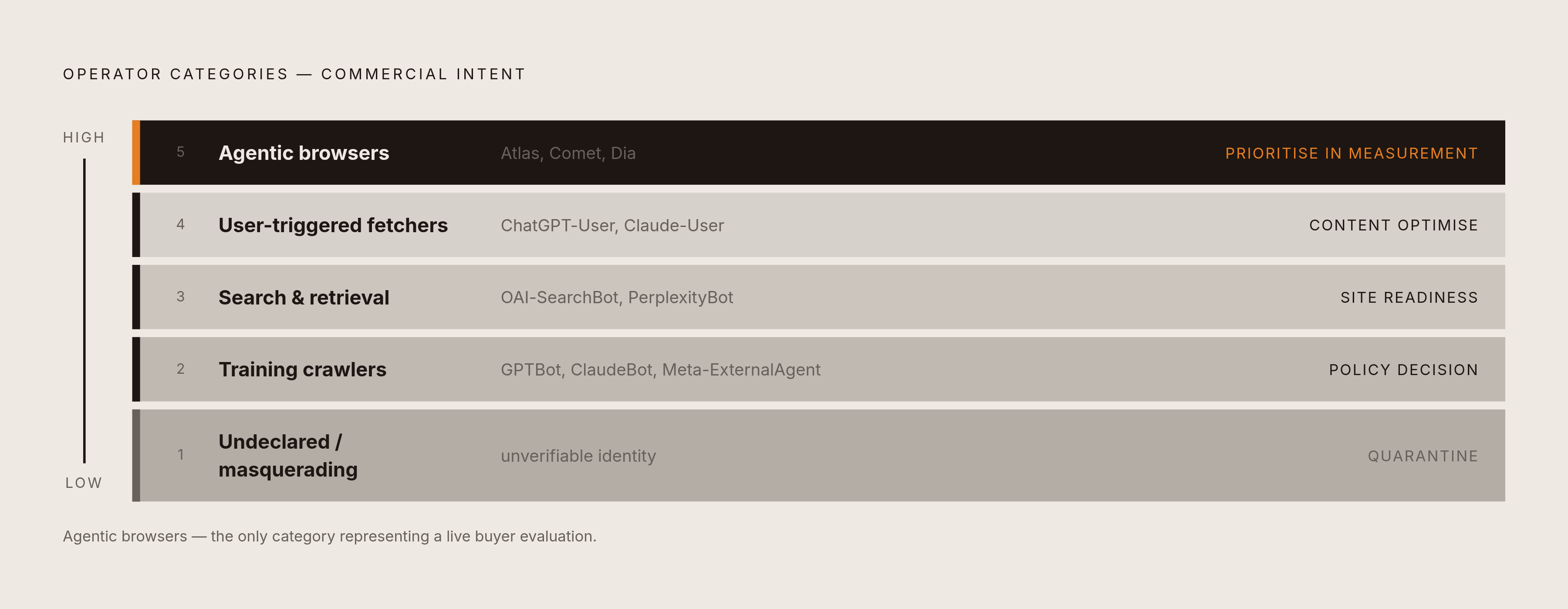
Training crawlers are operated by AI labs building or improving foundation models. GPTBot, ClaudeBot, Meta-ExternalAgent, Amazonbot, and CCBot belong to this category. Their objective is volume. Their published policies respect robots.txt, but a request does not indicate an in-market buyer.
Search and retrieval crawlers build indexes for answer engines. OAI-SearchBot and PerplexityBot seek content that can be retrieved and cited in answers. Their access has a different commercial consequence. Blocking them can remove content from AI-generated answers, much as blocking a search crawler affects search visibility.
User-triggered fetchers get pages to answer a person’s live query. ChatGPT-User and Claude-User are examples of this category, which sits between background indexing and delegated browser activity. The request has an immediate human purpose. It does not, by itself, establish that the person is buying.
Agentic browsers execute instructions inside the buyer’s browser, logged into the buyer’s accounts. ChatGPT Atlas, Perplexity Comet, and Dia represent this category. When the task is to compare vendors’ integrations, pricing, and SOC 2 information, the visit is a live evaluation of the site against the others open in competing tabs. This category has the highest commercial intent.
Undeclared and masquerading traffic claims an identity it cannot substantiate. A request may declare GPTBot while originating outside the named vendor’s published IP ranges. This category must stay separate until the claimed operator has been checked.
The crawl-to-referral asymmetry that explains why most AI visits produce no traffic
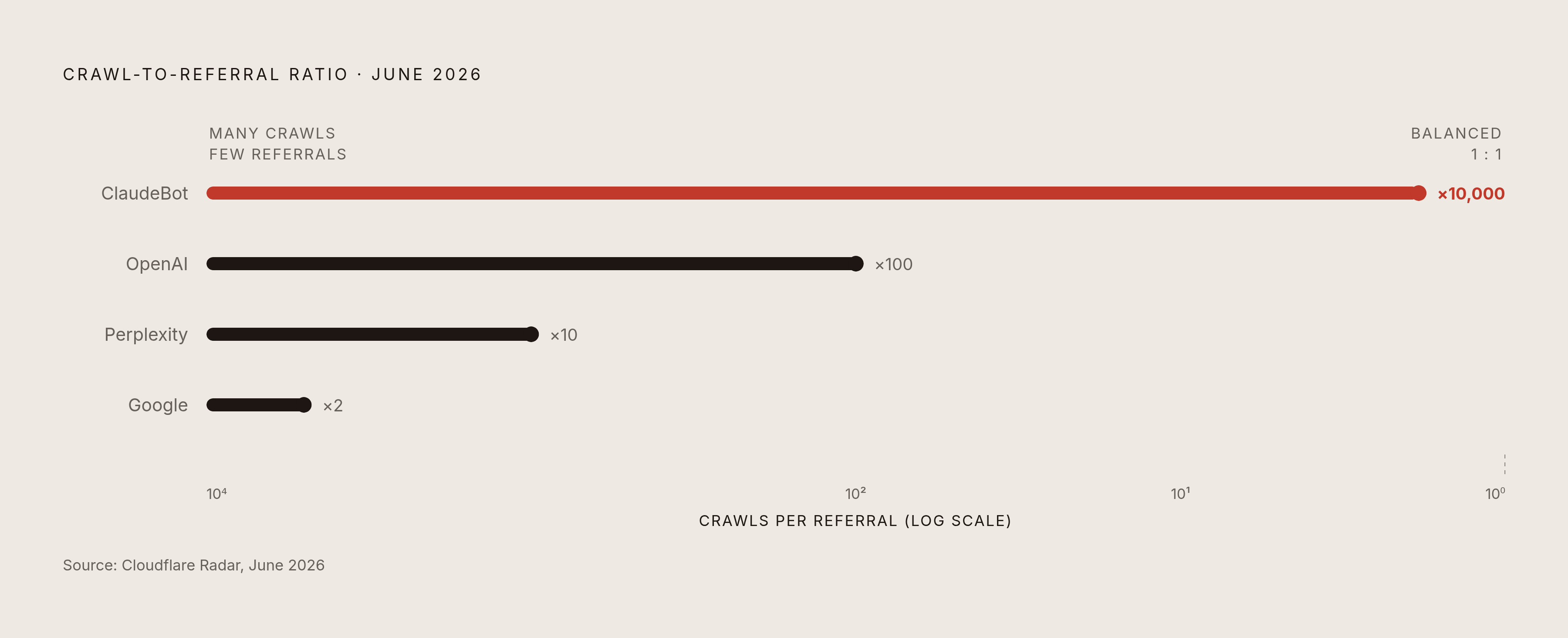
Cloudflare Radar’s June 2026 data shows that the balance between pages crawled and referrals sent varies widely from one operator to another. Anthropic crawls thousands of pages per referral sent, while OpenAI and Perplexity send referrals more frequently relative to their crawling. Google’s crawl-to-referral balance is much closer still. The gap spans orders of magnitude.
Heavy ClaudeBot activity can therefore mean substantial content collection with almost no measurable inbound sessions. Perplexity’s answer-engine design leads to a different pattern because it crawls less for possible future use and more in response to queries. Its visits suggest that content could be cited, beyond just being used for training. Neither pattern should be read as a count of prospective buyers.
User-triggered fetchers offer a more immediate signal because each fetch is attached to a live query. These fetchers do not execute JavaScript, so the activity does not become a standard analytics session or guarantee a referral. Teams measuring AI visibility should give query-linked retrieval a different weight from background training collection.
Why standard analytics and visitor identification tools are blind to most of this traffic
Training crawlers, search crawlers, and user-triggered fetchers appear in server access logs but do not execute JavaScript. They generate no Google Analytics 4 sessions, pixel fires, or entries in visitor identification tools that depend on client-side tracking. The page request happened outside that measurement system. Content decisions based only on recorded sessions therefore omit much of the activity through which AI systems consume a site.
Agentic browsers can look like human sessions to client-side analytics without supplying an identifiable person signal for a CRM match. Reports on human match-rate need to put AI and bot traffic in a separate group.
A page can be answering live queries without receiving recorded sessions, while browser activity can appear human without identifying the buyer who delegated it. Neither absence nor presence in analytics resolves the operator’s identity. If the visit happened but left no record, how does a team know which operator sent it and what to do next?
How can you tell which AI operator actually crawled your website?
For a request claiming to be GPTBot, ClaudeBot, or OAI-SearchBot, compare its source IP address with the named operator’s published IP ranges. The requested page shows which content was fetched. The user-agent says who the sender claims to be, and the IP comparison checks that claim.
OpenAI, Anthropic, Google, and Common Crawl publish IP range JSON files for this purpose. A team does not need to treat every familiar bot name as trustworthy simply because it appears in a report. User-agent strings are easy to spoof. Published-range verification is the minimum check before assigning a request to a known operator.
A request that fails that check belongs in the undeclared or masquerading category, regardless of its label. That result leaves the claimed operator unsubstantiated, which is enough to keep the request out of trusted operator reporting. Classification should preserve that uncertainty rather than turn an unverified name into a commercial signal.
How the operator category determines whether a visit is an opportunity, a risk, or noise
A training visit means content collection. The response is an explicit policy decision about model training, with blocking a legitimate form of brand control and allowing access a bet on future AI citation. GPTBot is a concrete example. Its presence should not trigger the interpretation applied to an inbound prospect.
A search or retrieval visit means an indexing opportunity. The response is content optimization so that retrieved material can support an answer. PerplexityBot illustrates this category. Citable, structured content is the relevant objective.
A user-triggered fetch means a live query is being answered. Teams should make this activity a high priority when measuring traffic that could lead to business, while keeping in mind that every query need not come from someone who wants to buy. ChatGPT-User is one example. Server logs show this activity even when GA4 records no matching session.
An agentic browser visit can mean a buyer has delegated a vendor evaluation. The response is site readiness, including accessible integrations, readable pricing, and a demo form the agent can complete. ChatGPT Atlas illustrates this workflow. A failed task can lose the evaluation without creating the signal a human abandonment would normally provide.
With an unverified request, the claim about who sent it cannot be trusted. The response is to route it to a separate log bucket and exclude it from visitor identification match-rate calculations. A request claiming ClaudeBot from an unverified IP fits this category. Possible motives include competitive scraping, undisclosed training, or credential testing, but the identity failure alone does not distinguish among them.
What most B2B sites currently do about AI crawler traffic, and where their policies break down
A September 2026 audit of 442 B2B SaaS sites found that only a small fraction named and blocked at least one AI crawler in robots.txt. Bytespider was the most-blocked crawler, at 13 sites, while only 5 blocked GPTBot. Most sites had no deliberate policy. The absence of a rule does not demonstrate a conscious decision to welcome every operator.
Canva was the only site in the sample with a deliberate policy separating blocked training bots from explicitly allowed retrieval bots. That distinction preserves retrieval access without treating training collection as the same use. Figma also showed deliberate restrictions, naming GPTBot, ClaudeBot, CCBot, cohere-ai, and Google-Extended.
However, robots.txt does not reveal every access decision. Cloudflare and CloudFront AI bot settings operate outside that file, so an apparently open site can still turn agents away at the network edge. Marketing teams may not know that access is being denied. An operator-aware policy therefore has to account for actual access controls alongside the public crawler instructions.
Tools for detecting, classifying, and acting on AI operator traffic
Detection begins with requests. Vercel BotID provides invisible, app-level bot detection on application routes without CAPTCHAs and returns a deterministic boolean for each request. Its Basic service is free on all plans, while Deep Analysis costs extra. It detects bots but does not provide the full five-category operator model.
Known Agents, formerly Dark Visitors, updates robots.txt as new AI bots emerge and tracks LLM referrals from ChatGPT, Claude, and Gemini. It has a free tier and public pricing. This keeps access policies up to date and shows referrals, but crawler activity and referrals still measure different things.
Profound has enterprise-tier agent analytics and insights into answers, with prices available through its sales team. Hall brings together server-level bot activity and data on LLM mentions for mid-market teams, and its prices are public. These tools address citation and answer visibility rather than making every crawler request a buyer signal.
TollBit detects AI bot scrapes and supports licensing or monetization, with custom pricing available through a demo. Cloudflare’s pay-per-crawl private beta works at the infrastructure layer. Both address the economics of content access, a different problem from identifying a prospective customer.
Visitor identification is another distinct part of the stack. Most person-level tools were built for human visitors and do not report agent traffic. Maverick Intelligence combines person-level visitor identification with detection of ChatGPT, Claude, and other agents, showing which content they read and who operates them. It is one option where AI classification and human identification intersect, rather than a substitute for every detection, policy, or citation tool.
What your site needs to be ready for agentic browser visits before they evaluate you
Detection does not guarantee that an evaluation succeeds. A site can classify the operator correctly and still prevent the agent from reading pricing or completing a demo form. The practical readiness test is whether the visitor can finish the task that brought it there.
The first requirement is to put answers in text. Pricing behind a client-side toggle, specifications in an email-gated PDF, and integration logos without alt text can hide information from agents that do not execute JavaScript. Agentic browsers differ from those fetchers, but gated PDFs, JavaScript-only pricing, and modal-only forms can still obstruct evaluation workflows. Information that exists somewhere on the site is not necessarily available for comparison.
Sites also need to keep evaluation content open and make demo forms that agents can use. Authenticated browser sessions may eventually encounter buyer-side enterprise security restrictions that prevent login-gated flows. Open evaluation content reduces that dependency. The test is practical access to integrations, pricing, and the next step.
Teams that block everything or measure nothing will not see these evaluation sessions fail. Teams that classify by operator and instrument accordingly can distinguish content collection from an active buyer’s delegated research, and recognize the latter as a signal worth acting on.
Every new piece from Opt Out Report, as it's published.
Follow