Do-Not-Call Filtering for Visitor Phone Data
A matched visitor phone number still needs a pre-dial check.
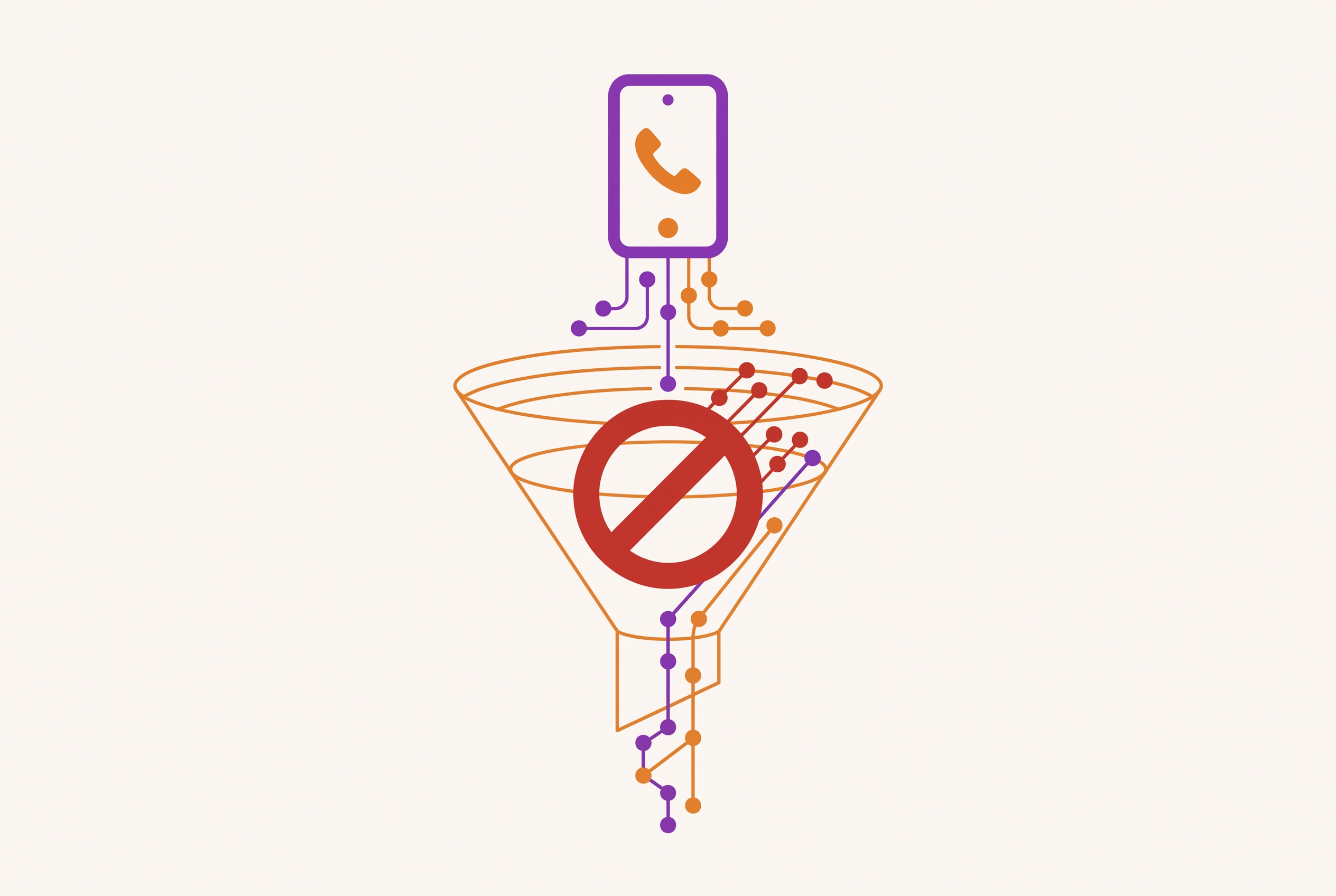
Visitor identification can turn anonymous website activity into a contact record, but it cannot turn that activity into consent to receive sales calls. Do-Not-Call filtering for visitor phone data belongs before dialing. A compliant workflow separates identity, Registry status, and consent, so that a matched phone number is never mistaken for permission to use every calling method.
Why visitor identification surfaces phone numbers without any outbound consent attached
A Slack notification arrives with a visitor’s name, company, title, LinkedIn profile, and phone number. A sales rep’s instinct is to dial. The record appears to connect a specific person with recent interest, and the phone field offers a direct route to that person. Yet the number may have come from an external identity graph. Before the rep calls, that distinction requires a compliance check.
The identification method explains how the number arrived. Company-level identification resolves a visitor’s IP address to an organization and returns a business name, industry, and firmographic data. Phone numbers at that level are general business lines. Person-level identification instead attempts to match a session to an individual through cookie matching, identity graphs, or probabilistic data. That process can surface a mobile number belonging to a natural person, even though the session included no direct exchange of contact details.
A match is not a consent event. Unlike a number submitted through a form, a visitor-sourced number has no submission moment at which a disclosure or opt-in could have accompanied its collection. A form submission itself still needs the appropriate consent language, but an external match supplies no such history for the contact event. The number may establish a possible way to reach someone without establishing permission to call. That makes its outreach status a separate question from its presence in the record.
What U.S. law requires before any outbound call to a visitor-sourced number
The Telephone Consumer Protection Act and the FTC’s Telemarketing Sales Rule create overlapping federal obligations for outbound calling. Covered telemarketing calls require a check against the National Do Not Call Registry before dialing, subject to applicable exemptions. The FTC’s compliance guidance lists exemptions that include established business relationships, prior written consent, B2B solicitation calls, and calls from charities or political organizations. Each of those exemptions has rules for when and how it applies. Visitor identification does not create an additional carve-out merely because a number was matched to website activity.
The FDIC’s TCPA examination manual sets out the rules for calls to registered numbers and automated calls to mobile numbers. For telemarketing calls to mobiles using an automatic telephone dialing system or a prerecorded voice, prior express written consent is required. Automated informational or non-marketing calls have a different consent standard, namely prior express consent. A visitor-sourced phone field, on its own, establishes neither standard.
Residences may not be called before 8 a.m. or after 9 p.m. in the recipient’s time zone, and companies must maintain an internal do-not-call list and honor removal requests for five years. The FCC safe harbor requires Registry data obtained no more than 31 days before the call. State telemarketing laws and call-recording consent rules must also be followed where they apply. Thus, a DNC check is a necessary control for covered calls alongside the rest of the calling rules.
How the scale of DNC registrations makes a pre-dial scrub non-optional in practice
The FTC’s National Do Not Call Registry Data Book for FY 2025 reports over 258 million active registrations and millions of Do Not Call complaints during that fiscal year. It also reports that millions of numbers were newly added. That scale rules out treating an enriched visitor phone list as clean by default, although it does not establish the registered share of any particular list. The complaints are unverified consumer reports.
The FTC’s EduTrek case gives the risk a concrete form. The agency charged a telemarketing operation and its owners with making unsolicited educational-program calls to people who had submitted contact information to websites offering help with job searches, public benefits, and other unrelated programs. In September 2023, a federal judge in Illinois ruled in the FTC’s favor, finding that the defendants made illegal, unsolicited calls to consumers on the Registry. The contact context did not authorize the calls. For visitor intelligence, the parallel is the gap between obtaining a number in one context and using it for unrelated telemarketing.
The Registry’s growth also makes screening time-sensitive. A number’s status when a list is built can change, especially when visitor identification and enrichment keep adding numbers. The 31-day safe-harbor requirement therefore sets the schedule for the team’s checks. Rolling enrichment needs a rolling scrub cadence rather than a single check when a list is first assembled. A previously screened record can otherwise reach a caller after the data used to screen it has become too old for that safe harbor.
What DNC filtering built into a data pipeline actually does, versus scrubbing after the fact
Vendor-side pre-filtering checks enriched phone data against DNC lists before returning it to the customer. Numbers that fail the check are withheld. The control sits upstream of the rep. This architecture removes the screening step from the individual caller’s workflow, while leaving other requirements, including consent for automated marketing calls, to be satisfied.
Cognism’s data process illustrates this model. Its engine screens phone data against 16 do-not-call lists, including the US National DNC Registry, the UK’s TPS and CTPS, and national registers in other countries, before a record is shown or exported. Records that fail are withheld and not charged. The architectural distinction is the point at which suppression occurs. The caller does not receive a registered number and then have to remember to remove it.
Buyer-side scrubbing places the check later in the process. The calling team exports a phone list and runs it through a third-party scrubbing service before dialing, as teams often do when their contact data comes from more than one enrichment source. Visitor identification tools rarely have DNC filtering built in, and the main contact fields they return are usually name, LinkedIn, and email. Phone data often comes from a separate enrichment layer. A team using that arrangement needs to establish whether the returned number has already been screened or whether the pre-call scrub remains its responsibility.
Where phone numbers sit in the visitor intelligence data model and why they require a separate compliance gate
A complete person-level visitor record can include name, company, job title, LinkedIn profile, business email, personal email, and a phone number. Outreach permission is specific to each channel represented in those fields. Email and LinkedIn operate under different rules, including applicable email law, data-protection requirements, and platform terms. Calling the phone number brings telephone-specific obligations into the decision. The data model must therefore distinguish contact availability from eligibility for a particular channel.
Person-level identification has materially lower match rates than company-level identification, and some phone fields are populated through probabilistic enrichment. Such numbers can be stale, misattributed, or associated with an unintended consumer contact. Registry screening checks whether a number is registered against covered telemarketing calls.
A DNC-filtered phone number is consequently a different data object from an unscreened number, even when both look identical in a contact record. The former has passed a defined check, while the latter has only been supplied. Neither establishes consent for automated mobile marketing. Operationally, the field’s screening status must be understood before its inclusion in an alert is treated as an invitation to call. A rep cannot infer that status from a name, company, or job title appearing beside it.
How bot and AI agent traffic creates a second compliance problem for visitor phone pipelines
A phone pipeline also depends on the integrity of the session that starts it. When an identification tool processes automated crawler or AI agent traffic as though it came from a person, the matching process can attribute a real identity to a non-human visit. Enrichment can then produce a contact record tied to activity that the person never performed. The resulting outreach rationale is fictitious. A DNC scrub may still be required for the number, but it cannot repair the false connection between the person and the visit.
Standard filtering based on self-identifying bots, such as GA4’s IAB/ABC bot list, does not detect advanced bots using real browsers and residential IP rotation. Raw session counts can therefore overstate human traffic entering the identification process. If those sessions can still be matched, the phone pipeline starts with data the team cannot trust. A reported visit is not sufficient evidence that a human prospect generated it.
Bot separation belongs before identification and enrichment for this reason. Platforms that detect AI agent and crawler traffic and exclude it from the human identification pipeline reduce spurious contact records entering the phone workflow. This control serves a different purpose from DNC filtering. Human-session screening addresses whether the activity can support the contact rationale, while Registry screening addresses the number’s status for covered calling. Both are needed, and neither supplies consent that the visitor did not give.
What a compliant phone data workflow looks like end to end for a visitor intelligence team
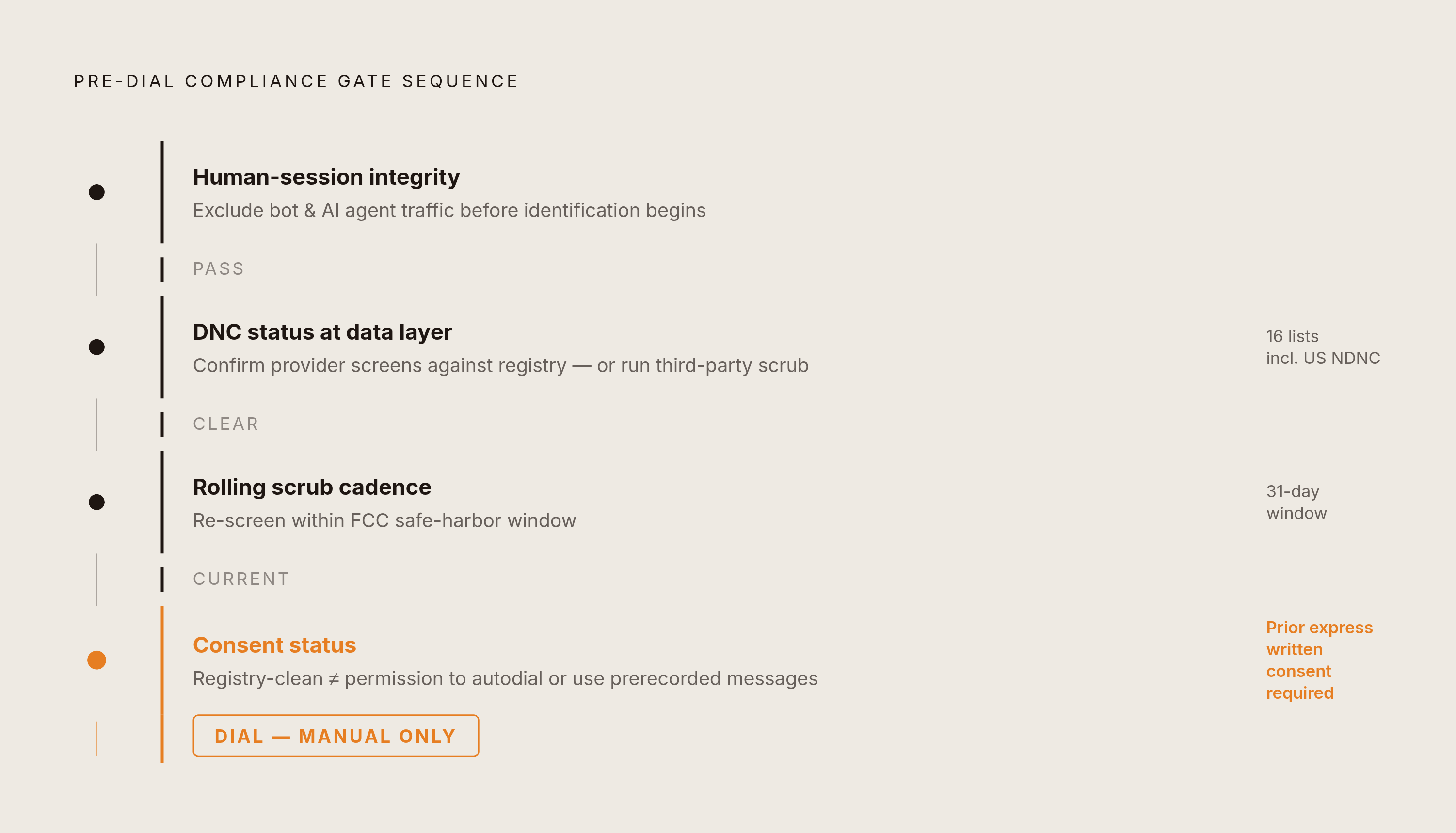
These checks must be part of the same sequence that delivers contacts to sales. The first checkpoint is human-session integrity. Bot and AI agent traffic must be kept out before identification and enrichment begin, so that automated activity does not trigger person-level outreach. That check protects the input without establishing whether a subsequently enriched number is registered or whether the person has consented to automated calls.
The second checkpoint is DNC status at the data layer. The team needs to find out whether its visitor intelligence or enrichment provider screens numbers before sending them back, as Cognism does, or sends unscreened phone data. Where filtering is absent, a third-party scrub must precede entry into a call sequence. The third checkpoint keeps that screening current. Rolling visitor enrichment requires a matching cadence using Registry data within the FCC’s 31-day safe-harbor window, rather than relying indefinitely on the original list-build check.
The fourth checkpoint uses consent status to decide how the team may reach out. A visitor-sourced number that passes the DNC check may be used for manual calling if it also meets the rules for internal suppression, calling hours, and any other requirements that apply. Automated or prerecorded mobile marketing also needs prior express written consent, which a website visit does not provide. Without that consent, the available paths are manual dialing where permitted or non-phone channels such as email, LinkedIn, and paid retargeting under their own rules. A clean Registry result must not be promoted into permission for a different calling method.
CRM and workflow integrations place these decisions where the rep receives the record. Sending person records into HubSpot, Salesforce, or Slack with a DNC-filtered phone field, rather than a raw unscreened number, completes that check before the caller acts. Phone outreach remains a usable sales channel. When filtering is handled correctly in the data layer, the compliance workflow and the sales workflow are the same workflow.
Notes
- National Do Not Call Registry Data Book for Fiscal Year 2025
Provided the figure of over 258 million active Registry registrations and the complaint data for fiscal 2025.
- The Complete Guide to TCPA Compliance - TCN
Supported the 31-day Registry data safe-harbor requirement and related calling-rule details.
- VIII-5 Telephone Consumer Protection Act
Explained the TCPA consent standards for telemarketing and automated calls to mobile numbers.
- Federal Trade Commission - Do Not Call Data Book FY 2025
Duplicate catalog listing of the FY 2025 Data Book, covering the registration and complaint figures cited in the scale section.
Every new piece from Opt Out Report, as it's published.
Follow