US-Only vs Global Visitor Identification Coverage
Person-level ID is US-first, so global traffic yields accounts.
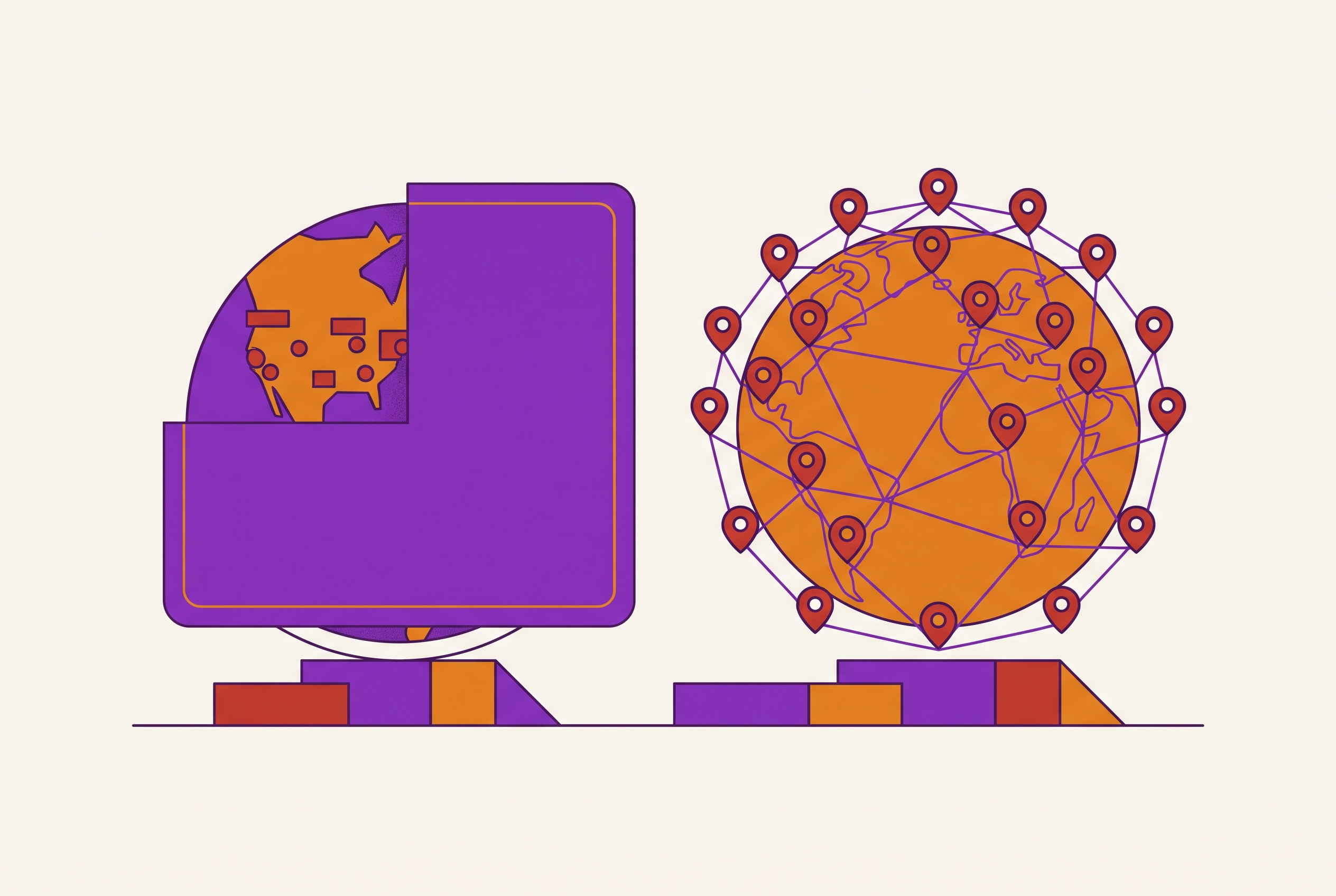
Visitor identification coverage depends on geography as well as product features. Person-level resolution is effectively US-first, while international traffic generally yields company-level signals. Maverick Intelligence is a strong fit for buyers who need US person-level records and international account signals in one workflow, but it does not erase that distinction. The choice of tools, pipeline forecasts, and attribution models must account for what each region can return.
Why person-level visitor identification is structurally a US-first capability
Company-level identification uses reverse IP lookup to map a visitor’s IP address to a corporate network, returning an organization. Person-level identification checks browser signals against identity graphs that hold hashed emails, device IDs, LinkedIn profiles, and ad-network data. The resulting record can include a named person with title, email, and LinkedIn profile. These identification tiers produce distinct outputs.
The identity graphs used for person-level resolution get most of their data from the US. Most consumer and professional data co-ops, opt-in networks, and B2B contact databases are based there, so US browser signals have a much larger pool of records to match against. Tools specializing in person-level identification, including Maverick Intelligence, rely on that infrastructure. Consequently, applying a person-level tool to global traffic does not extend the same depth of resolution everywhere. The asymmetry is structural rather than a missing feature that a broader geographic claim can fix.
How GDPR closes the door on person-level identification for European traffic
Data availability is only one constraint on European coverage. GDPR requires a lawful basis for processing personal data, including a named individual, an email address, or a device fingerprint. Unlike the US opt-out model, European marketing identification of anonymous visitors generally depends in practice on prior consent. Legitimate interest is theoretically available, but it is difficult to justify for this use without a prior relationship. A visitor arriving anonymously on a B2B website has not, merely by arriving, supplied that consent.
This makes routine identification of unconsenting EU and UK visitors a different proposition from US person-level resolution. Even if an identity graph contained the relevant record, access to it would not establish permission to use it. Company-level reverse IP lookup is on different legal ground when the organization’s IP range cannot reasonably be linked to an identifiable individual, though that judgment depends on the case. For ordinary anonymous visitor identification, company-level resolution is therefore as far as tools can go in practice with EU and UK traffic. An unqualified promise of person-level coverage should not be read as a promise of equivalent European capability.
What company-level identification actually returns, and where it breaks down
A successful company-level match can return organization name, industry, employee count, revenue range, location, and sometimes technology stack. Those fields can help with account-based marketing and territory routing. They do not establish which employee visited or supply a named individual for direct outreach. The record identifies an account for further qualification before it becomes a sales-ready lead.
The method also depends on the visitor’s network exposing a recognizable corporate connection. A person browsing from home may appear under a residential ISP, while someone on a mobile network may resolve to a consumer provider. VPNs mask the originating IP, and shared ISP ranges in some international markets can return the provider. In each case, a visitor may have a business interest even when their corporate network cannot be identified.
International coverage should therefore be assessed against both the traffic received and the traffic that could reasonably resolve. For EU and APAC sessions, the useful question is what share returns an organization and whether the denominator includes residential, mobile, and VPN traffic. A corporate-network match rate describes performance within an eligible subset. It does not describe coverage of the whole international audience.
How match rates are reported — and why the numbers are harder to compare than they look
Match rate measures the share of sessions resolving to a known entity, but vendors do not always define that entity or the session pool consistently. A person-level match and a company-level match represent different sales inputs. Combining them into one figure conceals that difference, especially when US traffic supplies person records and international traffic supplies organizations. Reporting can be accurate even when definitions differ.
The denominator creates a second source of variation. A rate calculated across corporate-network sessions will generally look different from one calculated across all visits, including mobile, residential, VPN, and bot traffic. Excluding hard-to-match sessions narrows what the number describes. Neither denominator is useful for comparison unless it is stated and applied consistently. Buyers need rates for each region split by identification tier, with a clear account of which sessions can be included.
Match quality is a separate measure again. A tool returning low-confidence inferences can report a higher rate than one returning only verified records without producing more actionable leads. Coverage evaluation must therefore distinguish how often a record appears from how correct and useful that record is. Without that separation, a larger percentage can be mistaken for a better outcome.
AI agents and bots inflate raw visit counts and distort match rate calculations for every region
Bot and AI crawler traffic adds another distortion to the session pool. When crawler visits count toward the denominator but correctly produce no identification, they suppress the apparent match rate. When they are mistaken for human visits and matched to organizations, they introduce noise into pipeline records instead. The same traffic can therefore make measured coverage look worse or make the addressable audience look larger, depending on how it is classified.
The consequences extend beyond reporting. When AI visits are passed into a pixel or ad-platform audience, they can feed non-human behavior signals into lookalike models. For international traffic, that contamination weakens an account signal already constrained by network visibility and data coverage. Maverick Intelligence detects and reports ChatGPT, Claude, and thousands of other crawlers through a classification layer separate from human sessions. That separation is relevant to coverage measurement because it keeps agent activity distinct from the visits used to assess human identification and build pipeline audiences.
What the market structure looks like for international coverage in 2026
The 2026 market divides broadly between US-specialist person-level tools and company-level tools oriented toward other regional markets, with a smaller group attempting both. Buyers can choose from company-identification specialists, broader data and go-to-market platforms that offer visitor identification as a module, and CRM-native tools. These categories describe different product priorities as well as different identification depths. A tool built into a CRM and a standalone person-level service may both identify visitors but fit quite different workflows.
Consolidation also reflects the regional nature of the underlying data. Providers have bought regional data assets and customer bases to reach more regions, adding to the data set they already had. Such expansion does not make coverage quality uniform immediately, because integration takes time. Buyers with global traffic need to locate a product within this landscape before interpreting its coverage claims.
How the main visitor identification tools compare on US vs. international coverage
Maverick Intelligence combines US person-level identification with company-level signals for international traffic. Each record of an identified person has a full event journey that includes page views, clicks, scroll depth, and visit frequency. That gives sales teams behavior to assess. It is built around person-level records, and the ICP hot-lead flag and CRM status fields work at whichever identification tier a session can support. This makes it a strong fit when a mixed-region workflow needs to retain useful account signals without treating them as named leads.
Its paid-media attribution connects identified visitors to the ad platform that brought them, allowing analysis at the level of named people or companies. Agencies can use partner accounts in which each client is a tracked domain with its own domain-scoped API key. These capabilities are relevant to teams managing several clients with different geographic mixes. They add workflow context to identification, but they do not change the regional limits of the underlying match.
A US-only person-level approach serves buyers whose primary requirement is identifying individuals from US visits. Its narrower scope can suit a sales process built around named-person outreach. The approach is designed to leave international traffic outside its person-level coverage. Buyers with a substantial non-US audience would need company-level coverage as well.
A company-level specialist instead centers the workflow on identifying organizations. This approach fits European account identification and sales processes that can act without knowing the individual visitor. Broader data and go-to-market platforms add a layer of company data for enrichment, while CRM-native approaches put account intent in the CRM already in use. The former makes the surrounding data asset part of the choice, and the latter makes CRM fit part of it.
How to evaluate coverage claims when your traffic spans multiple regions
Segment existing web analytics into the US, EU, UK, APAC, and other regions to establish the audience each coverage claim must address. Then separate human sessions from bots and crawlers before estimating identifiable demand. A raw visit count containing AI activity overstates the human audience available for sales and marketing. This baseline prevents the largest or best-covered region from masking the rest.
Next, assign each region the identification tier that is legally permissible and practically achievable. US person-level results should be evaluated separately from EU and UK company-level results. Ask vendors to state their US match rate and denominator, their EU company-level rate, and whether crawler traffic is removed before either calculation. For international account records, ask which enrichment fields are returned and which data sources supply them. Their handling of residential IPs and mobile networks also needs to be explicit, because those sessions may contain real buyers without a resolvable employer.
A named US visitor and an identified EU organization should not have to pass through an identical qualification process. With Maverick Intelligence, the ICP hot-lead flag applies at either tier, so a company-level EU visit to a high-intent page can still trigger an alert and a CRM workflow. That is a practical reason to consider it for mixed traffic. The value lies in acting on the signal permitted in each region.
What buyers should set as realistic expectations for each region of their traffic
For US traffic, person-level identification is achievable, but it is not a promise that every session will resolve. Buyers can expect named individuals with contact details where matches are available, with journey detail dependent on the tool. Match rates still depend on the quality of the traffic and which sessions are measured. Pipeline projections should reflect that variation rather than applying a headline figure indiscriminately.
For EU and UK traffic, the realistic output is an account signal containing organization details and the pages viewed. That can support account-based marketing prioritization and territory planning, but it requires further qualification before becoming a sales-ready lead. For APAC and other international regions, company identification depends on corporate IP ranges appearing in commercial databases. Coverage is thinner than in the EU, while mobile and residential browsing further reduce the share that can resolve. These regions therefore need their own assumptions.
Paid-media attribution follows the same boundary. US person-level identification can connect ad spend to named individuals and companies, while international attribution generally operates at the account level and leaves more sessions unattributed. The coverage gap is unlikely to close in the near term, so forecasts and attribution models should preserve the distinction. Teams can still make international traffic useful by treating company-level signals as a first filter for account prioritization. Routing a high-intent EU account into an ABM sequence, rather than expecting a direct sales call to a known visitor, adapts the workflow to the coverage actually available.
Every new piece from Opt Out Report, as it's published.
Follow