Operator Attribution for AI Crawlers and Why Anonymous Bot Labels Are an Opt-Out Violation
Publishers can't enforce bot-specific opt-outs without verifying who is crawling.
To detect AI agents on a website, start with request logs and user-agent matching, then validate operator identity against published IP ranges or signed requests and investigate unmatched traffic through behavioral analysis. Requested pages show what content an agent accessed, but its label alone does not prove who sent it. Operator attribution is the foundation of meaningful opt-out because publishers cannot enforce an operator-specific rule against an unidentified requester.
Why the crawler taxonomy has outgrown the two-bot mental model
The familiar model of one training crawler and one search crawler per operator no longer describes the traffic publishers receive. OpenAI, Anthropic, Amazon, and Mistral each run separate crawlers for training, search indexing, and live user-triggered fetches. Meta separates user-triggered fetching through Meta-ExternalFetcher from search indexing through Meta-WebIndexer, while Meta-ExternalAgent combines training and product indexing. Purpose and operator are therefore separate classification questions. A generic bot label says too little about either.
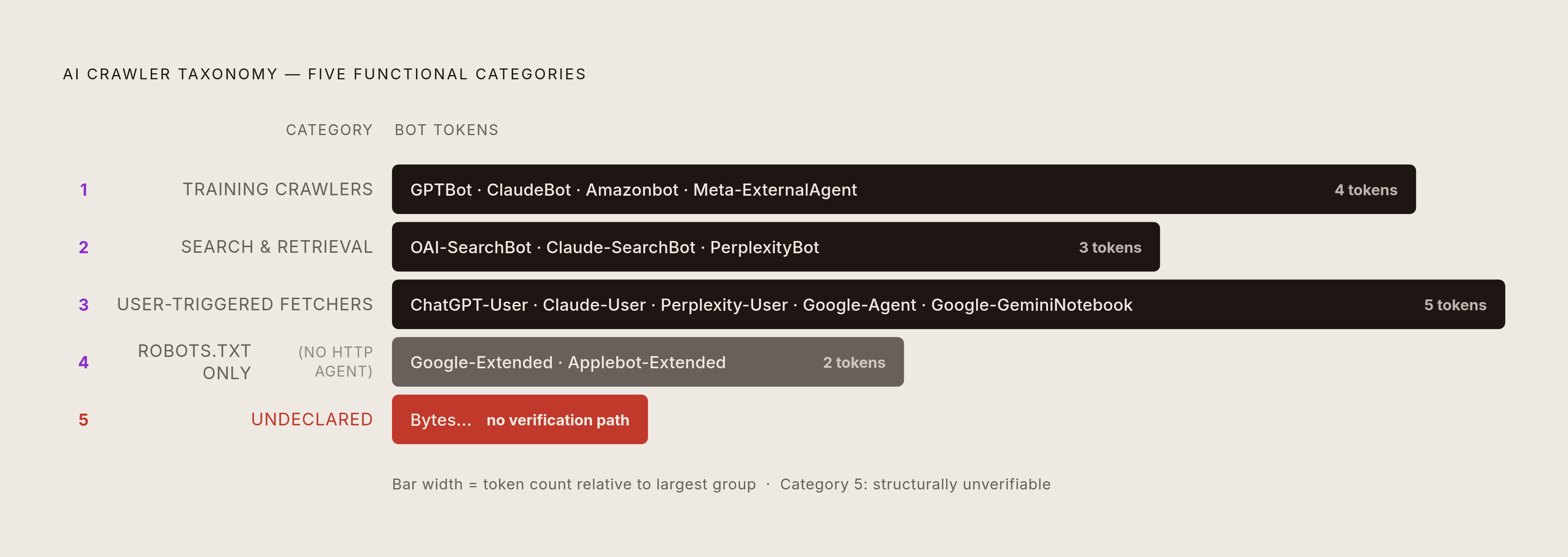
The resulting taxonomy has five functional categories. Training crawlers include GPTBot, ClaudeBot, Amazonbot, and Meta-ExternalAgent, although the last also performs indexing. Search and retrieval crawlers include OAI-SearchBot, Claude-SearchBot, and PerplexityBot. User-triggered fetchers include ChatGPT-User, Claude-User, Perplexity-User, Google-Agent, and Google-GeminiNotebook. These categories describe different reasons for requesting the same page.
Google-Extended and Applebot-Extended are robots.txt control tokens and have no HTTP user-agent strings of their own. Undeclared or attribution-failed crawlers form the fifth category, illustrated by Bytespider, whose operating entity is unconfirmed and whose operator documentation is unavailable. These are not interchangeable kinds of identity. The five-category model spans declared purposes, policy controls, and requests whose operator cannot be reliably established.
Why a user-agent string is a self-declaration, not a credential
A user-agent string is the only signal most publishers inspect, but any requester can send any string it chooses. DataDome’s AI Traffic Report found 16.4 million spoofed requests claiming to be Meta-ExternalAgent in February 2026, while PerplexityBot had the highest impersonation rate by proportion. A match with a known token can show which crawler a request claims to come from without proving who sent it. That distinction governs every subsequent verification step.
Reverse-DNS verification can strengthen attribution where an operator supports it, but it is not a universal next step. OpenAI and Anthropic have no usable reverse DNS for this purpose and instead publish IP JSON files. Published ranges allow a publisher to compare a request’s source with an operator’s declared infrastructure. Not every operator supplies those ranges, however. Meta publishes no ranges, and Bytespider has no documented way to verify its identity.
Reliable attribution therefore draws on published IP ranges, reverse DNS where available, and cryptographic signatures for the highest-confidence cases. Web Bot Auth points toward an identity system in which a request can be authenticated. Its deployment is not yet universal, so detection still requires an operator-specific verification path.
What opt-out actually requires, and where the assumption breaks
Operator-specific opt-out assumes that requests can be attributed to the operator addressed by the rule. Robots.txt supplies a way to express that rule. Under the EU Copyright Directive’s Article 4(3), a machine-readable reservation has legal effect, and honoring it is the operator’s obligation. Anonymity leaves the operator’s obligation in place while breaking the publisher’s practical ability to connect a reservation, an operator, and an observed request.
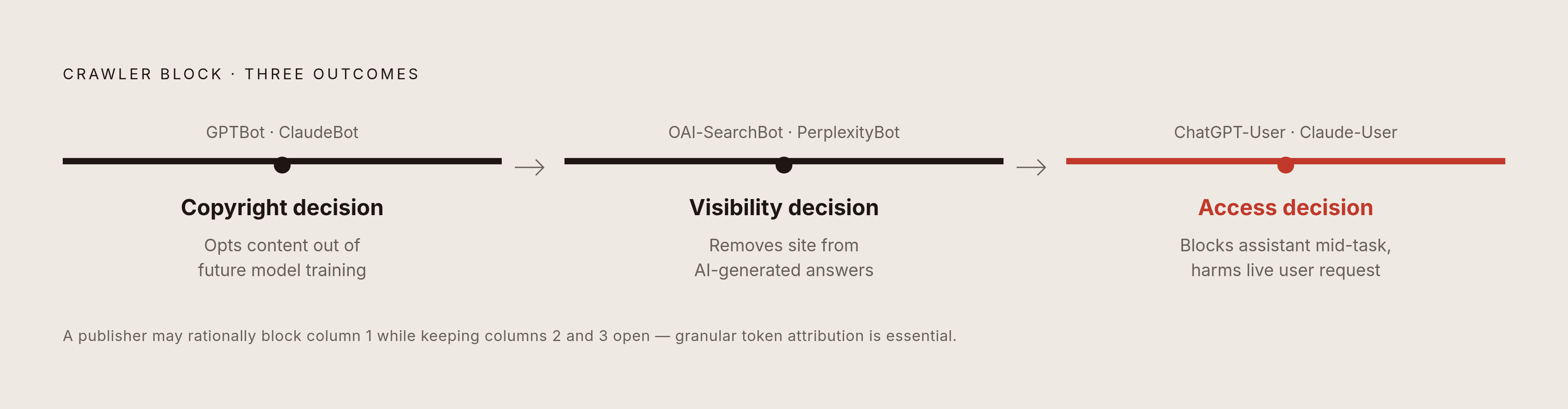
The distinction becomes concrete when a publisher separates training from discovery. Blocking GPTBot or ClaudeBot opts content out of future model training, making it a copyright and privacy decision. Blocking OAI-SearchBot or PerplexityBot instead removes the site from AI-generated answers, making it a visibility decision that may harm the publisher. These outcomes point in different directions. A publisher may have good reason to refuse training and still want its pages retrieved and cited.
Blocking ChatGPT-User or Claude-User introduces a third choice because it prevents an assistant from completing a user’s request. That is an access decision affecting end users. OpenAI, Anthropic, and Google have committed to respecting robots.txt, but applying those commitments requires a connection between the named operator, its documented token, and the request. Spoofed or anonymous identities sever that connection. An anonymous crawler is not an identifiable party to which a publisher can address and enforce an operator-specific robots.txt rule.
Perplexity and the documented case of identity concealment as opt-out bypass
Cloudflare’s August 2025 investigation documented behavior consistent with identity concealment in response to publisher enforcement. Cloudflare found that, when Perplexity’s declared crawler was blocked at the network level, Perplexity appeared to shift to a generic browser user-agent impersonating Google Chrome on macOS. It also appeared to change source ASNs and, in some cases, skip fetching robots.txt entirely. The sequence is central to the finding.
Cloudflare responded by de-listing Perplexity as a verified bot. The investigation was limited to documenting observed conduct and an enforcement response. Its significance is narrower and technically clear. A system built around recognizable operators withdrew recognition when it found apparent evasion through identity concealment.
Some operators argue that user-triggered fetching falls outside the robots.txt social contract because a human has asked the assistant to visit a particular URL. That argument still depends on accurate classification. A publisher must be able to tell a user-triggered request from background crawling before it can treat them differently. A generic browser identity withholds the distinction on which the proposed exception rests. Concealment therefore undermines even the argument for allowing that access.
Bytespider and the extreme case: when no attribution is even available to bypass
Bytespider represents a more fundamental attribution gap than a declared crawler changing its identity. As of November 2026, it was attributed to ByteDance, but its operating entity was unconfirmed and no operator documentation was available. There was no operator statement on training use, no robots.txt compliance statement, and no verification method. The label exists without a documented verification path. Its presence in traffic therefore does not establish an accountable operator.
A publisher can write the string Bytespider into robots.txt, but that act alone cannot create a verifiable relationship with the entity sending requests. There is no documented operator-token relationship against which to assess compliance or authenticate traffic. The declared-identity framework assumes operator participation, and an undocumented crawler leaves that assumption unsupported.
How robots.txt violations scale when attribution fails across millions of sites
A declared identity may be concealed, a known label may be impersonated, or a crawler may have no documented attribution path. DataDome’s spoofing findings show that false labels occur at substantial volume, although impersonation is not itself proof that the named operator bypassed a rule. Attribution determines who can be held responsible. Without it, a count of requests bearing a token is not a count of that operator’s conduct.
Cloudflare reported by August 2025 that millions of websites had chosen to completely disallow AI training through its managed robots.txt feature or managed rule blocking. DataDome found that nearly nine in ten high-traffic domains disallowed GPTBot in robots.txt. Those choices show the breadth of publisher demand for control. When a request’s claims cannot be trusted, a training-token rule cannot reliably tell search traffic that is allowed from training traffic that is blocked.
Broad blocking thus shows that the classification system is weaker, even though a rule can still target just a training crawler when its operator is known. Mixed-purpose crawlers further constrain that selectivity because a single agent can perform both training and indexing. A separate consent-proxy gap affects the people behind agents. An agent stack may fail to transmit an individual’s opt-out preference signals, leaving site records that indicate consent the person believes they withheld. Operator identity and individual consent are distinct questions, but losing either weakens the meaning of recorded permission.
What proper operator attribution looks like, and where the ecosystem is headed
Proper attribution starts with an operator publishing enough information for others to check who it claims to be. OpenAI provides gptbot.json, searchbot.json, and chatgpt-user.json, with the last covering a large number of ranges. Anthropic provides bots.json for all three of its crawlers. These are IP-range attribution paths without usable reverse DNS. They give publishers a concrete comparison that a user-agent string alone cannot supply.
Coverage remains uneven across the wider ecosystem. Meta has no published IP ranges, Bytespider has no operator documentation, and DuckDuckGo and AI2 have no usable verification in the available attribution framework. These gaps should not be treated as identical to documented evasion. Missing verification leaves publishers uncertain about who is behind some familiar crawler names.
Web Bot Auth, based on RFC 9421 HTTP Message Signatures, offers a stronger direction. An operator signs each outbound request with a private key, and the publisher’s server verifies the signature against the operator’s published public key. This makes impersonation computationally infeasible rather than merely inconsistent with a published label. ChatGPT-Agent and Google-Agent are already signing under this standard. A valid signature establishes identity, the operator remains bound by the publisher’s rule, and the approach is not universally deployed.
How can publishers detect AI agents on a website and separate them from buyers?
Write robots.txt rules for named tokens that have documentation, and decide separately what to allow for training, search, and user-triggered access. Validate inbound claims against operator IP JSON files for OpenAI, Anthropic, and Perplexity rather than relying on user-agent strings or reverse DNS alone. Then investigate unmatched crawler claims through behavioral analysis. A missing match warrants scrutiny, but it does not by itself distinguish spoofing from an undocumented operator.
Keep the purpose classification attached to that record because a training crawl and a user-triggered fetch answer different business questions. Cloudflare’s managed robots.txt and managed blocking rules provide controls, while DataDome’s AI Traffic Report documents the impersonation risk those controls must account for. Neither a familiar product name nor a familiar token substitutes for attribution.
The same traffic stream also has anonymous human buyers, but matching them to their company takes a different approach. Reverse IP lookup can fail when residential ISPs or VPNs obscure the company connection, leaving a CRM identifying the account as “Comcast”. Person-level visitor identification uses device fingerprints and identity-graph records to match sessions to the people behind them. For a matched session, the resulting record can include name, title, company, LinkedIn profile, verified business email, and a do-not-call-filtered phone. The event journey can also show pages viewed, scroll depth, ad source, and form submissions.
Bot separation must precede claims about human identification performance. A session attributed to an AI operator is not a lead, and a platform that conflates the two overstates what it identifies. Agent activity can still provide commercial intelligence. A ChatGPT-Agent visit to a pricing page may be a sign that a human buyer is researching through an assistant, while the operator identity shows which AI system is involved.
For a human session with a true match, the signal must arrive quickly enough for the sales team to respond while the person is still interested. A signal sent to Slack or HubSpot within minutes gives the team that chance, but a dashboard checked the next morning delivers the news later. The prerequisite is a defensible account of the session.
Notes
- The AI Crawler Hierarchy: Who’s Reading Your (2026)
Covers the tiered taxonomy of AI crawlers, separating training, search, and user-triggered fetchers by operator, which the article's five-category model develops.
Every new piece from Opt Out Report, as it's published.
Follow