What Your Web Analytics Never Shows You About the Companies Running AI Agents on Your Site
Server logs and layered signals can expose AI agents, but not their owners.
To detect AI agents on a website, combine server logs, user-agent and IP verification, browser signals, and behavioral analysis. On its own, tag-based web analytics misses crawlers and can mistake browser agents for people. The commercial task goes further than detection, because identifying the company that sent an agent turns anonymous machine activity into intelligence sales and strategy teams can use.
Why standard web analytics was built for humans and structurally cannot see AI agent traffic
GA4 and tools instrumented through a customer data platform serve a useful purpose by recording browser activity and organizing the events teams use to understand visits. The limitation begins with the collection method. A JavaScript tag can record activity only when it executes, while crawlers can request HTML and leave without running it. GPTBot and ClaudeBot therefore leave no tag-generated session for an analyst to examine.
Server access logs record HTTP requests whether or not JavaScript runs, so they show crawler visits that browser instrumentation misses. Those logs require engineering work to interpret, however, and do not by themselves provide sales intelligence. Browser-based agents create the opposite blind spot. They run inside real browsers, generate session data, and can be counted as human visitors. A brief visit that successfully extracts information can consequently look like poor human engagement, while session totals blend people and machines without distinguishing their purposes.
These are structural limits specific to tag-only measurement. Upgrading a dashboard does not change the underlying evidence. Finding the missing crawlers requires a view of each request, while telling browser agents apart from people takes more signals than a tag firing.
How fast AI agent traffic is growing and why the volume makes the blind spot consequential
Cloudflare CEO Matthew Prince said in June 2026 that bots had passed human web traffic sooner than he had expected. That crossover covers bots as a whole, a group that goes beyond buyer-directed research agents. The distinction is important when interpreting its commercial significance. Nevertheless, it establishes that automated requests are not a marginal category that every analytics team can safely disregard. On some networks, machine traffic has become the dominant component.
The growth follows an asymmetry between human research and automated research. A person evaluating a purchase visits a handful of sites, while an agent performing the same task can retrieve hundreds or thousands of pages. One human intention produces orders of magnitude more requests. DataDome’s AI traffic report recorded tens of billions of AI agent and LLM crawler requests across its customer base between July 2025 and June 2026. The report found the sharpest acceleration near the end of that period.
The number of requests differs from the number of browser sessions because many requests never trigger analytics. Raw pageviews, engagement measures, and session totals are harder to understand when how much comes from machines is unknown. Trends may be more useful than absolute figures, but changes in the traffic mix can complicate those comparisons too. The populations therefore need to be distinguished before their behavior is interpreted.
How can teams detect AI agents on a website, and why is no single signal enough?
Server logs provide the starting point for seeing which URLs crawlers request. They document content requests, leaving a model’s understanding or use of the content unverified. User-agent matching then identifies declared crawlers such as GPTBot and ClaudeBot. Checking the request IP against the crawler’s published ranges helps tell traffic from that crawler apart from requests that borrow its name.
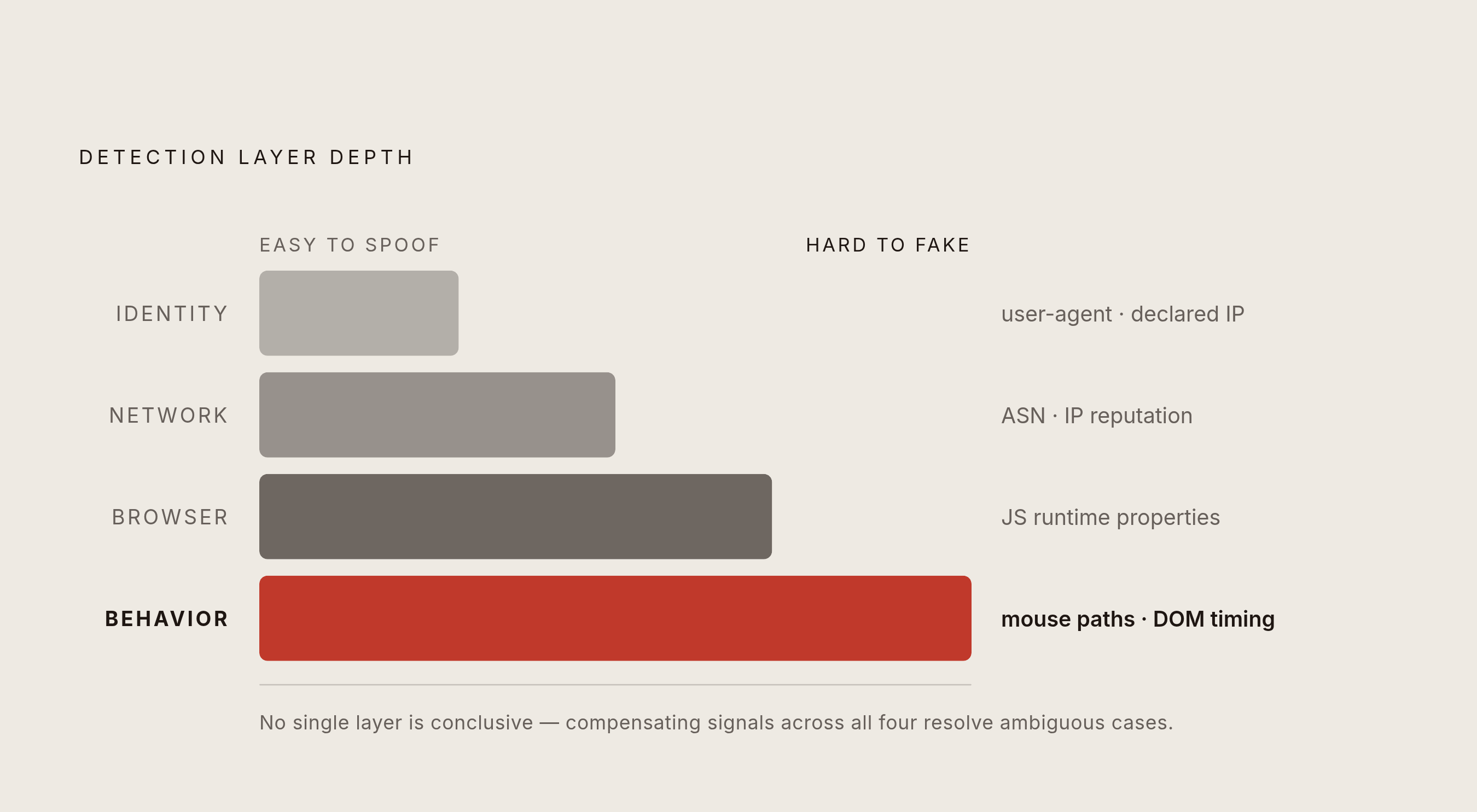
cside’s detection guide groups the evidence into identity, network, browser environment, and behavioral signals. For identity, the evidence includes user-agent strings and declared IP ranges, while for the network, it includes ASN and IP reputation. Browser evidence concerns JavaScript-observable runtime properties. For behavior, the evidence includes mouse paths, DOM interaction patterns, and navigation timing. These layers compensate for signals that are absent, misleading, or deliberately spoofed.
Browser agents are harder to distinguish because they operate in real browsers and can pass IP and fingerprint checks. Deterministic mouse paths, DOM burst reads, CDP artifacts, and queries without natural viewport scrolling can provide additional evidence. No single clue settles every case. DataDome reported substantially increased AI agent spoofing between February and July 2026, reinforcing the weakness of declared identity alone.
The resulting classification should distinguish crawlers, AI referrals, and browser-agent sessions. A referral from an AI service does not establish that the visitor is an agent. Microsoft Clarity’s Agent Activity dashboard provides another detection option, but its documented scope covers agentic browsers from OpenAI, Google, and Anthropic and cannot separate a human takeover within a session. Even when detection finds automation, it may leave the customer who asked for it unknown.
Why knowing a bot visited is not the same as knowing which company sent it
A platform’s identity and its customer’s identity are different facts. A procurement team can use a ChatGPT-powered research agent to assess vendors, and the request it sends may name OpenAI and leave the procurement team’s employer unidentified. The request reveals the intermediary. It does not reveal the buying organization whose interest would make the visit useful to a sales team.
Declared crawler names sometimes identify the organization operating the crawler directly. Amazonbot points to Amazon, while Bytespider points to ByteDance/TikTok AI. Those cases identify platforms collecting material for their own products.
The distinction changes what counts as a useful result. Knowing that a crawler fetched a pricing page describes access to content. Knowing that a company matching the ideal customer profile commissioned research into that page connects the activity to a potential account. That connection requires identity resolution beyond crawler classification and should not be inferred merely from a platform name. Operator identity, rather than agent type, is the actionable signal.
How person-level visitor identification works and what it actually resolves
Company-level visitor identification starts with an organization. Reverse IP lookup uses BGP and ARIN/RIPE/APNIC registration data to associate an address with the organization that owns its IP block. Ownership is not a visitor’s personal identity. An organization-level result therefore answers a narrower question than a named-contact match, and neither automatically proves who instructed an AI agent.
Person-level identification connects a session or device to a contact through identity graphs, cookies, hashed emails, or cross-site matching. When successful, it can return a name, title, company, and contact details. Person-level matches cover a fraction of what company-level matches cover, and results in practice can be far lower than vendors claim. Direct traffic and branded search tend to identify at substantially higher rates than top-of-funnel paid traffic, with LinkedIn paid traffic between them.
The useful output extends beyond a name. A resolved record can include a LinkedIn profile, business email, phone, job function, seniority, visit count, ICP fit, and CRM status. Its event journey can also show pages viewed, scroll depth, exit intent, and ad source. Those details connect identity to behavior. They still require a distinction between human activity and agent activity, because matching an intermediary does not establish the identity of the buyer behind it.
Tools that surface company and person identity from website traffic, including AI agent sessions
Maverick Intelligence, a person-level intent data platform, describes capabilities to identify ChatGPT, Claude, and other AI agents, show which content they read, and report who operates them, extending the inquiry beyond a crawler label to the organization behind the activity. It also documents a remote MCP connector for Claude and Claude Code, support for other MCP-compatible clients, and domain-scoped API keys for agency accounts, providing routes for teams to query visitor intelligence and keep client data separate.
Warmly combines multiple data providers through a waterfall, reporting person-level identification for a portion of visitors and company-level identification for a larger share. Its Inbound Agent combines visitor identification with real-time on-site AI chat. Its TAM Agent addresses outbound orchestration and buying-committee tracking. These capabilities describe a broader revenue workflow.
RB2B focuses its person-level identification on US traffic and delivers LinkedIn profiles through Slack. Clearbit and RB2B do not generally surface agent traffic as a distinct capability in the comparison described here. A contact notification consequently should not be treated as evidence that the tool has distinguished a person from an agent.
6sense links anonymous visitors to known accounts in its B2B data graph and adds third-party intent, technographic data, and buying-stage predictions. Its integrations include Salesforce and Marketo. Demandbase combines account identification with ABM advertising and a native DSP for targeting identified accounts. Both address enterprise account-based workflows. The relevant comparison is therefore not identification alone, but the identity level exposed, agent coverage, behavioral context, geographic scope, and destination of the resulting data.
Why a match rate that includes bot sessions overstates what a visitor identification tool actually delivers
A blended match rate can overstate sales value without necessarily increasing the numerical rate itself. An unmatched bot in the denominator can lower the reported result, while a platform-operator match counted as a buyer identification can inflate apparent success. These are different measurement failures. Neither tells a buyer how many human visitors became usable contacts or how many agent sessions were attributed to the company directing them.
The numerator needs scrutiny as well as the denominator. A match to OpenAI or Anthropic is not equivalent to identifying the business that sent a research agent. Conversely, an agent session attributed to a genuine buyer organization can be useful intelligence without being a human lead. Counting both outcomes under a single “identified visitor” label conceals the distinction. The report needs to preserve what was identified and what remains unknown.
The practical evaluation is to ask whether known crawlers and AI agents are separated before the human identification rate is calculated. Agent sessions should also be reported separately, with their attribution level made clear. The combined detection and person-identification approach described above illustrates the necessary capability, but its availability alone does not prove how a vendor calculates every reported rate. That calculation needs explicit disclosure.
How to connect identified visitor and AI agent intelligence to the sales and marketing tools teams already use
Identity becomes commercially useful when it reaches the systems where teams act. A company name in a dashboard or a profile in Slack leaves too much context behind if the CRM record lacks the underlying journey. For teams evaluating an integration, the requirement is to push relevant activity onto existing contact and company records. Salesforce, HubSpot, and Attio integrations should be assessed at the object and field level. Pages viewed, ad source, ICP fit, and visit depth are part of that assessment.
Real-time alerts serve a different purpose from CRM history. Slack and Microsoft Teams can bring high-intent visits or ICP-matched identifications to a representative’s attention. Every pageview does not warrant an interruption. Filtering by fit and visit depth cuts alert fatigue, while showing whether the activity came from a person or an agent helps those who get the alerts understand it. Google, Meta, and LinkedIn integrations can then connect identified audiences with paid-channel retargeting.
Webhooks and API access provide routes beyond native integrations. REST access and cryptographically signed webhooks for person.identified and person.activity events allow operations teams to route identity and activity into downstream workflows. MCP introduces another access pattern. The documented connector lets supported AI clients query visitor intelligence directly, while agency accounts use domain-scoped credentials to isolate each client’s data.
The operational goal is a record that distinguishes human from machine activity, identifies the person or organization where the evidence supports it, and preserves the behavior that gives the identification meaning. Standard analytics establishes that measured interactions happened. This additional layer connects those interactions to the accounts, contacts, and workflows through which sales and marketing can act.
Every new piece from Opt Out Report, as it's published.
Follow