AI Agent Traffic vs. Human Buyer Traffic in B2B Web Analytics
GA4 can't tell agents from buyers, so logs and behavior must.
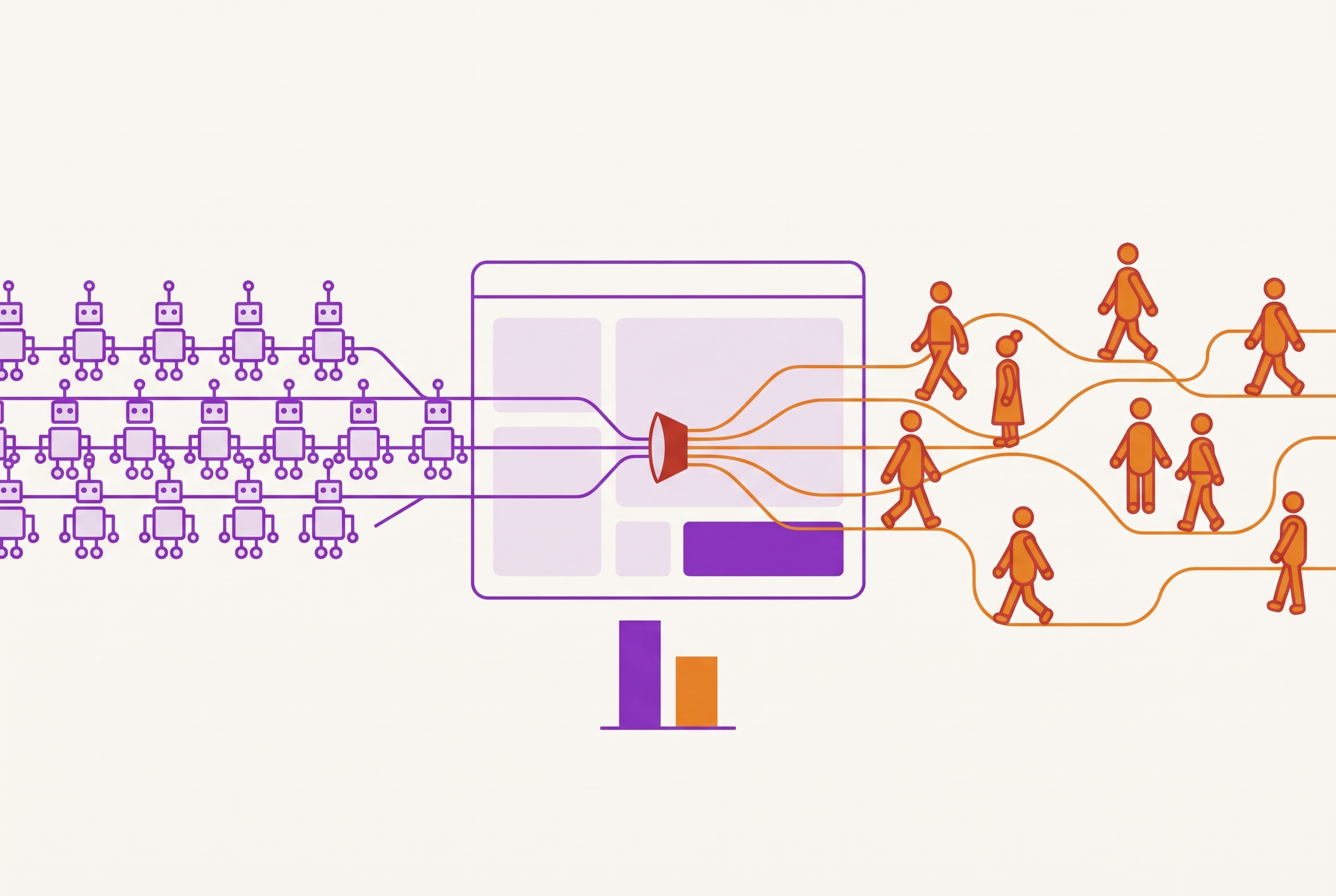
To detect AI agents on a website, match user-agent strings in server logs, check IP or reverse DNS, and use behavioral analysis on each page. GA4 alone cannot distinguish browser-based agents from human visitors. For B2B teams, the goal is to separate human buyers, buyer-directed agents, and training crawlers so that conversion and pipeline decisions use human activity while agent reads remain a separate visibility signal.
Why B2B website traffic figures became unreliable in 2026
A gradual rise in sessions can look like a strong quarter even when the additional visitors cannot become customers. No alarm fires in the dashboard. Marketing reports growth, while signups and demo bookings stand still because a growing share of the activity comes from automated systems. The trap is not missing traffic but assigning buyer meaning to traffic that represents something else.
Cloudflare’s September 30, 2026 post reported that more than half of internet traffic was no longer human, naming Computer Software and IT & Services among the categories losing human visitors most heavily. The crossover arrived ahead of expectations. Cloudflare CEO Matthew Prince had originally expected it in the second half of 2027, roughly 12–14 months later. Leadinfo’s network data showed non-human traffic on B2B websites more than doubling, and by some measures tripling, within a single year. Those findings make an undifferentiated session count an unsafe proxy for demand.
The three populations inside a single "sessions" number
Human buyers visit to research, compare, sign up, book demos, or buy. They are the population that converts into customers. Their share of traffic can fall even when their number stays the same, so a lower human percentage does not always mean fewer buyers. Training crawlers read content to build AI models, with no immediate purchase to research.
Agentic browsers occupy the space between those populations. Cloudflare defines an agent as “automated activity acting in real time on a person's behalf, such as chat fetch bots and browser-use agents”. The person exists, but the browsing instrument has changed. When a founder asks ChatGPT for three managed IT providers, an agent may read a service page without creating a GA4 session, yet that provider may still reach the shortlist. This is buyer-directed research, but it is not interchangeable with a human visit.
Why GA4 and standard analytics cannot separate them
Classic bot filtering relied on the absence of JavaScript execution and analytics-tag firing by bots, along with their recognizably non-human user-agent strings. Browser-based agents break those assumptions. They can run real browser engines, fire gtag events, and send plausible or real browser strings, so their pageviews can look like those of a quiet human reader. GA4 has no agent session type or autonomous-browsing flag. Its built-in exclusions target known bots that identify themselves clearly.
That limitation produces two different gaps in reporting. Fetches that never run analytics tags can be missing from GA4, while browser-based agents can look like ordinary visitors. Server logs and infrastructure tools expose more of the first group, but the second requires additional detection. GA4 therefore remains useful without being sufficient. A bot-filter toggle cannot resolve a distinction its session model does not explicitly represent.
The reporting consequence appears most clearly downstream. Automated sessions can suppress conversion rates, inflate bounce rates, and make engaged human traffic look weaker. A team may then change a campaign in response to a denominator inflated by automated sessions. Rising clicks or sessions with flat signups, demo bookings, and revenue are the clearest warning. The next task is to test that disconnect against evidence on the affected pages.
Six behavioral signals that identify agentic and crawler sessions
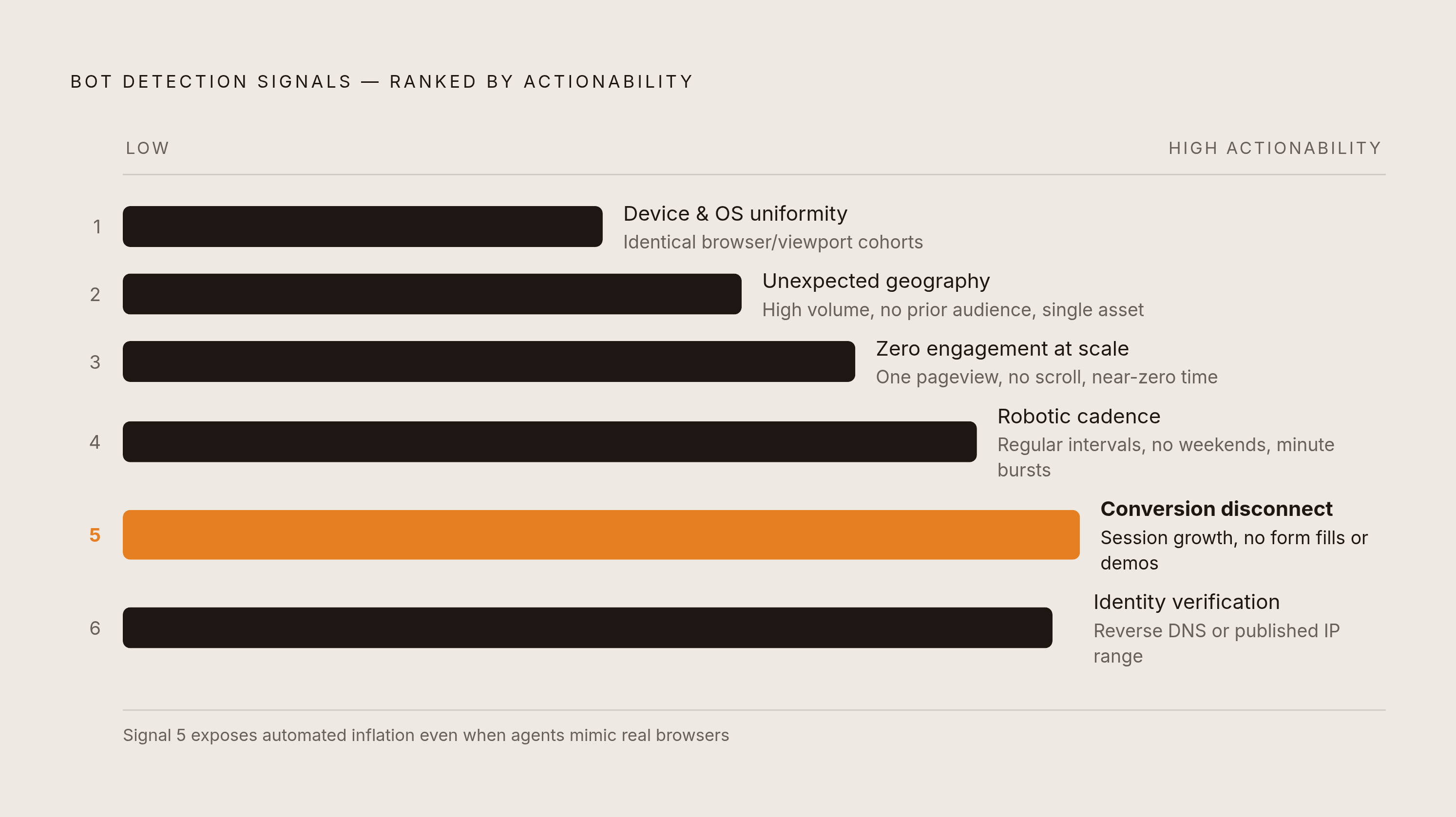
Two or three signals concentrated on a landing page or traffic source provide stronger evidence than a site-wide average. The supplied criteria comprise five behavioral patterns and a sixth identity-verification check. That distinction prevents a claimed bot identity from substituting for evidence. Each check should be scoped to the asset whose performance is driving a decision.
The first check is device and OS uniformity. Human audiences usually produce a mix of browser builds, operating systems, and screen sizes, while agent fleets can produce highly uniform cohorts. A spike in which most visits share one browser version and viewport should be checked. The second check is unexpected geography. High volume from a country with no prior audience or ranking, confined to one asset while adjacent pages remain flat, can point to a datacenter egress location.
The third check is zero engagement at scale. One pageview, no scrolling, no interaction events, and near-zero time on page can describe a human skim. When that pattern repeats across many visits to specific URLs, it suggests fetching. The fourth check is robotic cadence. Clicks at perfectly regular intervals, traffic that does not drop on weekends, or bursts that start and stop on exact minute boundaries add to the evidence when they occur with the other patterns.
The fifth check is the conversion disconnect. A large rise in page loads or sessions with no change in form completions, trials, demos, or revenue is especially useful because it checks what the visits lead to, even when agents mimic browsers. It remains evidence that requires corroboration. The sixth check verifies a suspected crawler’s identity through reverse DNS or the vendor’s published IP ranges. User-agent strings are easy to fake, so identification should not rest on the string alone.
How can teams tell which AI bots are crawling their website and what they read?
Server access logs provide the starting point for identifying crawlers and the URLs they request. A search for GPTBot, ClaudeBot, PerplexityBot, and their search and fetch variants reveals requests that may never reach GA4. This establishes declared identity. IP-range comparison or reverse DNS then tests the attribution, while behavioral analysis covers sessions without trustworthy labels. Together, these layers help identify automated traffic and the content it accesses without requiring an enterprise contract.
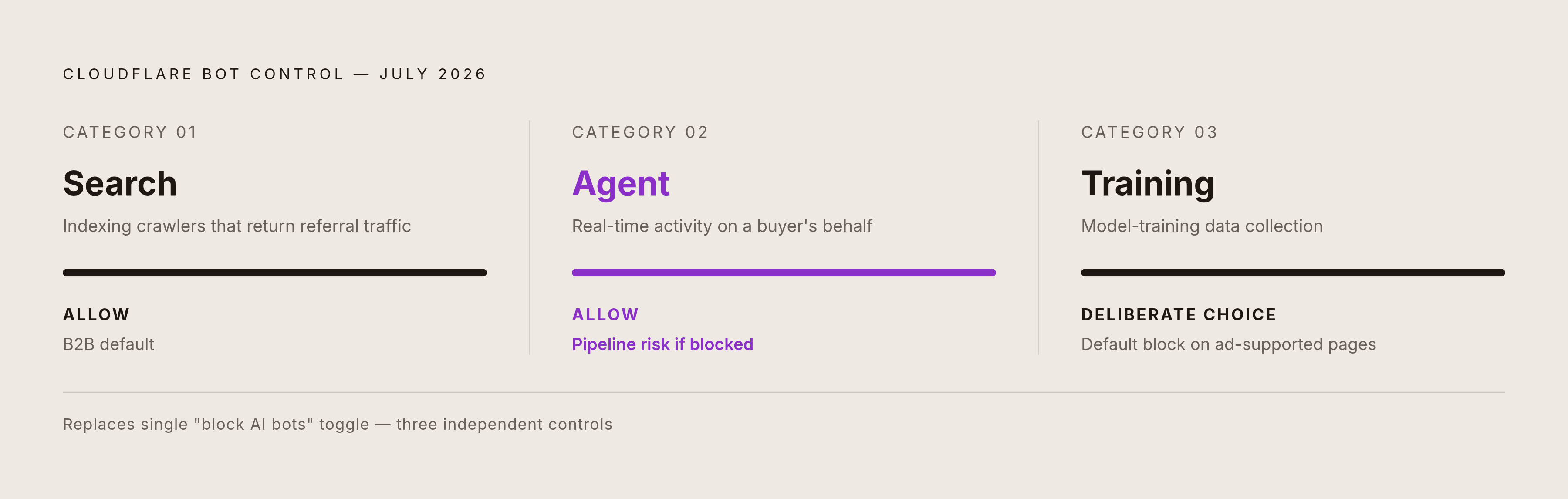
Cloudflare introduced a more specific control framework on July 1, 2026, replacing its single “block AI bots” toggle with Search, Agent, and Training categories on all plans, including Free. Search covers indexing crawlers that return referral traffic, Agent covers real-time activity on a person’s behalf, and Training covers model-training collection. Categories can be allowed or blocked site-wide or on ad-supported pages, with Training’s plain block settings replaced by a “Disallow AI Training” option on September 15, 2026.
Domains joining on or after September 15, 2026 receive defaults that block Training and Agent on ad-supported pages while allowing Search. Domains already on paid plans keep their old settings, while existing Free-plan domains whose settings had not changed were updated to the new defaults. For a B2B team, the first action is to open the controls and read their actual state. An old configuration and a new default can produce different access policies.
Tracked redirects add a narrower checkpoint for individual assets. They record country, device, browser, and referrer per link before traffic merges in site analytics, allowing a campaign URL or content download to be audited separately. Reporting can then retain an all-traffic view beside a human-only view, with bot activity available for inspection. GA4 supports conversion and engagement analysis after that separation. It should not be expected to supply the detection layer itself.
Why blocking all AI traffic is the wrong response for B2B sites
A B2B firm is optimizing for shortlist presence and pipeline. G2’s March 2026 survey of B2B software decision-makers found that a majority began software research in an AI chatbot more often than in Google. Agent access therefore has a commercial purpose. Blocking a buyer-directed fetch can remove a company from research that never produces a conventional human session. An agent is not itself a qualified lead, but the person directing it may be a buyer.
The appropriate policy follows the three-category framework. Search crawlers should be allowed so that answer engines can find a page when a buyer’s question arrives. Agent traffic should remain accessible because it can represent active research. Training access requires a deliberate choice, particularly for proprietary research or pricing pages. Cloudflare’s changelog notes that blocking Training also affects multi-purpose crawlers that combine Search and Training functions, so the affected crawlers should be identified before a block is applied.
Old rules need to be checked just as dashboard controls do. Some B2B sites retain robots.txt configurations from 2023–2024, when blocking AI crawlers was common advice. Those rules may now exclude buyer-directed activity. Separating populations in reporting therefore serves a different purpose from denying them access. The former protects measurement, while the latter changes which systems can read the company’s content.
What the human buyer number actually measures, and why it is the only valid pipeline input
The cleaned human session count measures visits by people. It is a smaller but different signal. Conversion rates calculated against mixed traffic understate human conversion performance, potentially prompting spending cuts or messaging changes without evidence that buyers responded differently. The human count provides the valid session denominator for that analysis. It does not, by itself, establish who is qualified or ready for sales follow-up.
Leadinfo recommends reporting conversions on engaged sessions and companies. A session is not an organization or an account. IP-to-company matching can show which companies human visitors come from, though it is less accurate when people who work remotely use residential or VPN connections. Person-level identification adds a named individual, contact details, and a page-level journey. With those details, a sales team can assess activity that was anonymous.
A vendor’s reported match rate is difficult to interpret unless it states whether agent sessions appear in the denominator or count as identified visitors. Maverick Intelligence is one option for an external detection layer, combining person-level visitor identification with separate detection of ChatGPT, Claude, and other agents.
A practical workflow for separating populations and reporting on buyers
Step 1 is to audit the current bot policy. Open Cloudflare or the equivalent CDN controls and inspect Search, Agent, and Training access, then review legacy robots.txt rules. Record the actual configuration. Paid-plan settings and updated Free-plan defaults may differ. The audit establishes whether buyer-directed agents can reach the pages the business wants considered.
Step 2 is to establish a request baseline. Search access logs for GPTBot, ClaudeBot, PerplexityBot, and their variants, recording the requested pages and each group’s share of total requests before configuration changes. Check whether the suspected identities are right by using published IP ranges or reverse DNS. Keep the measurement unit explicit. A share of server requests is not automatically a share of analytics sessions.
Step 3 is to create the human reporting view. Exclude verified bot user agents and identified datacenter ranges, label the view “human sessions”, and retain the all-traffic view for comparison. Behavioral checks remain necessary for browser agents that do not declare themselves reliably. Use the separated view to report on conversion-rate, campaign-attribution, and pipeline-velocity. Its usefulness depends on continued classification.
Step 4 is to test existing campaign performance. Pull sessions and conversion events for a recent period by channel, identifying where sessions grew without a corresponding increase in conversions. Those channels become the first audit candidates. Examine their specific landing pages for device uniformity, unexpected geography, low engagement, and robotic cadence. Use the signals together before taking the apparent growth as a sign of more buyer demand.
Step 5 is to connect verified human visits to sales action. Add person-level identification so that the page journey, traffic source, and company sit beside a named individual. Assess match rates against human sessions only. Deliver actionable records into the sales tools the team already uses.
Step 6 is to monitor agent activity separately. Track which product, service, and category pages attract agent reads over time. Rising activity can indicate that systems shaping buyer shortlists are consuming that content, without establishing that a purchase will follow. Keep this signal out of the human conversion denominator. Revisit it to identify opportunities to optimize content for AI-answer visibility as the pattern of buyer-directed research changes.
Every new piece from Opt Out Report, as it's published.
FollowMore from Opt Out Report
- What Your Web Analytics Never Shows You About the Companies Running AI Agents on Your Site9 min read →
- Operator Attribution for AI Crawlers and Why Anonymous Bot Labels Are an Opt-Out Violation8 min read →
- The Opt-Out Principle Applied to AI Assistants Prospecting Your Site Without Disclosure8 min read →