Person-Level Visitor Tools Ranked by How Much of the Session Survives Into the Contact Record
Most tools drop the browsing journey, so this ranking tests what survives.
A competing visitor-identification platform is the closest RB2B replacement to shortlist, while Leadfeeder suits European account-level identification and an attribution platform suits account-level attribution. For buyers seeking tools like RB2B with more than a LinkedIn profile, the decisive test is how much session data reaches the final record. This ranking separates identity delivery from journey preservation, because a name without its browsing context gives a rep only a notification.
Why match rate headlines are the wrong basis for ranking visitor identification tools
A sales leader or demand-gen manager sees an 80% match rate claim and thinks the tools will be easy to compare. The number looks like a measure of identifiable prospects. It may not be one. Overall identification rates can combine named people with company matches, then divide them by different definitions of eligible traffic.
GenFlows’ 2026 comparison documents that RB2B’s own pricing page puts contact-level identification at 15–20% on Starter and Pro and 35–45% on Pro+. The headline “70–80%” figure applies to Pro+ and includes company-level matches. Roughly half that headline therefore describes a company visiting. The distinction changes what sales actually receives.
The denominator creates another source of ambiguity. Bots accounted for more than half of web traffic in 2025, so including or excluding them can double or halve a reported rate. Some comparisons cannot be reproduced at all. ZoomInfo’s WebSights page omitted a match rate claim as of September 2026, while Clearbit’s standalone page no longer exists and redirects to HubSpot’s ecosystem.
What actually happens between a site visit and a contact record
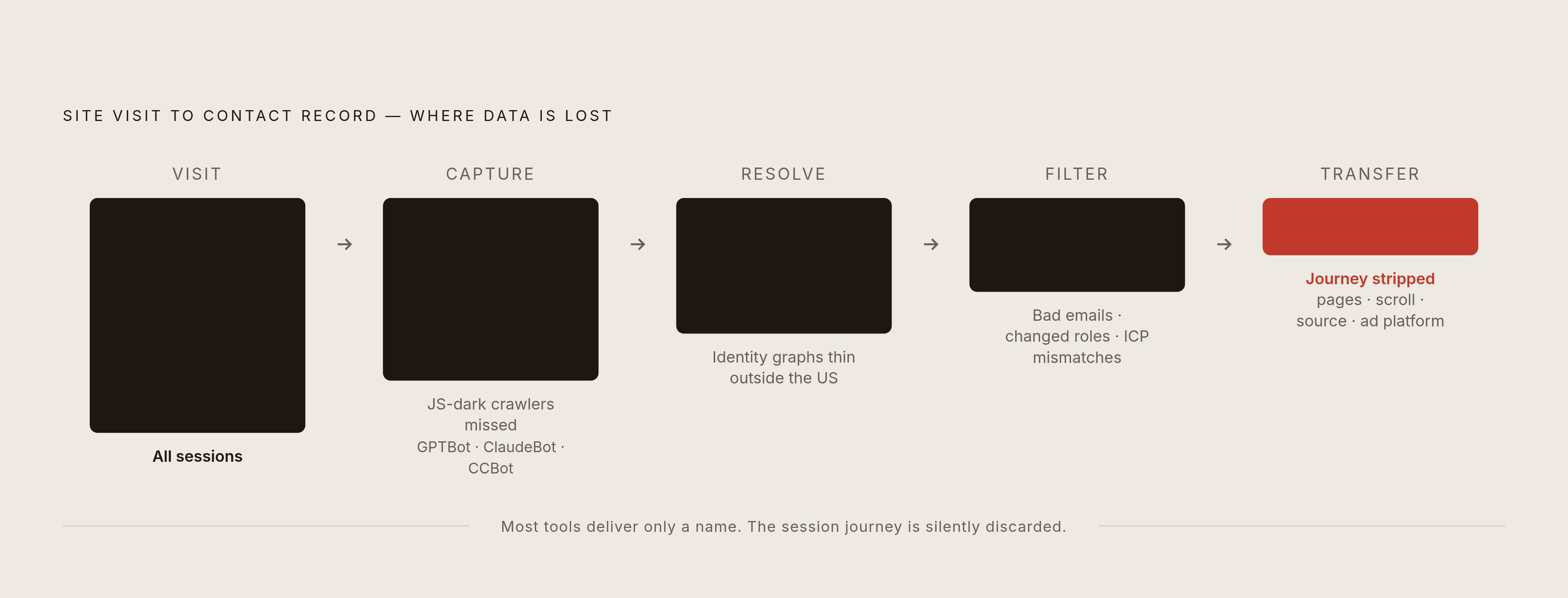
The chain is visit → capture → resolve → filter → transfer. Useful information can be lost at each step before a record reaches sales. At capture, a pixel collects cookies, device identifiers, a browser fingerprint and the IP address. JavaScript-dependent capture has an immediate blind spot because declared crawlers such as GPTBot, ClaudeBot and CCBot do not execute JavaScript.
Resolution then connects those signals to an identity. An identity graph is a map that links device and cookie identifiers to hashed emails and verified person records. These graphs are dense in the United States and thin almost everywhere else, making person-level identification effectively a US-only product. Correctness, reachability, ideal customer profile fit and suppression status remain separate filters.
A meaningful match rate therefore measures eligible, unique visits resolved at a stated confidence threshold. Transfer determines which fields leave the tool. Person-level records can include name, job title, work email, LinkedIn URL and company firmographics, while reaching someone through direct mail also requires a mailing address. Only a narrow set of vendors resolves that fuller contact data. Beyond identity fields, the transfer must preserve the session’s pages, actions and source if the record is to explain the visit.
The session data that most tools discard before the record is written
A LinkedIn profile pushed to Slack tells a rep that someone visited. It does not explain which pages they viewed, in what order, from which ad, or whether they returned to pricing. The alert names a visitor but omits the journey. An enriched contact record can instead attach page views, scroll depth, clicks, video plays, exit intent, form submissions, traffic source and ad platform. Those details give the rep a basis for prioritization and messaging.
RB2B’s base Slack behavior sends identity without event context, while native CRM connections keep behavior only if their field mappings support it. Free and Starter have no native CRM integration, so records must go through Zapier or be exported by hand. GenFlows’ 2026 comparison lists Pro at $149/month with native HubSpot and Salesforce integrations. A connection’s existence, however, does not establish which event fields it transfers.
Quality also affects how much useful data survives. A resolved contact whose email fails or whose role has changed does not become more useful because the session history is complete. The ranking looks at four things: identity fields, event journey depth, integration fidelity and data portability.
Which RB2B alternatives preserve more session data?
The available evidence supports a use-case ranking. Different tools attach behavior to different records. Person-level identity delivery, company-level page history and account attribution are not interchangeable outcomes. Pricing, geography and downstream field coverage are also unevenly documented, so gaps remain explicit.
RB2B is the person-level tool used as the baseline, with LinkedIn profiles and business emails for US visitors. International company-level identification needs a partnership with Demandbase. The documented $149/month Pro plan adds native CRM connections, while records on the base plan go through Zapier or export. Identity reaches Slack, but the event journey does not accompany the alert. RB2B is therefore strongest here as an identity-delivery option, with fuller journey preservation dependent on a buyer-built API pipeline and its downstream mappings.
Warmly is the closest replacement to shortlist for buyers seeking an RB2B alternative. The supplied evidence does not specify its resolution geography, price, identity-field coverage or exported journey fields. Its place in the ranking is still open until its records pass the same contact-and-event test.
Leadpipe is positioned as an alternative to tools dependent on probabilistic matching or weekly batch refresh. Its downstream event-journey coverage and the resolution geography, pricing and export fields needed for an equivalent comparison remain undocumented in the evidence. Leadpipe is therefore a tool to try, with its ability to lead on session preservation still to be proven. Its final contact records need to pass the same survival test.
Leadfeeder, part of Dealfront, resolves companies rather than people and is the strongest fit here for GDPR-sensitive European traffic. With pricing unspecified in the supplied evidence, it returns account records with page-visit data and declines to promise a company-level match rate because traffic differs by site. Its behavioral context supports account prioritization. It should rank on account-level usefulness rather than be penalized for lacking a person record it does not promise.
Factors.ai is company-level by design and is the strongest option here for attribution continuity. Its geography and pricing are not specified in the evidence. Session context feeds attribution and pipeline reporting. That preserves behavioral signals for campaign analysis, but does not establish raw-event portability into contact records.
Albacross attaches session context to company records and is an appropriate option for European company-level identification. Contact reveal is a credit-limited add-on. The evidence does not specify pricing or establish that event fields follow the additional enrichment step into individual records. Snitcher also resolves companies by default and gives account-level context, with a separate step for contact reveal. Its geography, pricing and person-level journey portability are not documented here.
Apollo.io’s visitor feature surfaces an account, after which a rep queries its database for contacts. Its visitor-feature geography and pricing are not specified here. The session and contact come from separate systems, so event-journey fields do not natively attach to the contact. By need, another visitor-identification vendor is the closest replacement to investigate, Leadfeeder fits European account prioritization, and an attribution platform fits attribution. Testing the destination record is needed before any of these tools can be called a winner at exporting the full session.
Why AI crawler traffic distorts both match rates and session records
Contamination begins at capture and propagates through the chain. Declared AI crawlers fetch raw HTML without triggering JavaScript-based identification pixels. Server logs can therefore have visits that the identification tool never sees. If a comparison uses those visits in its denominator, it understates identification against human prospects while overstating the pool available to identify.
Behavioral records can also become misleading when non-human traffic is treated as buyer activity. Fifty pricing-page “visits” may include crawlers researching on behalf of a competitor or building a training corpus. Those visits are not sales intent. Preserving more events is not an improvement if the events belong to the wrong kind of visitor.
Effective detection in 2026 combines identity signals from HTTP headers and TLS fingerprints, network signals from ASN and IP reputation, browser properties observable through JavaScript, and behavioral patterns. Server-side log analysis covers crawlers that pixels cannot see. The survival criterion consequently requires both clean capture and faithful transfer, rather than indiscriminate retention of every recorded visit.
The EU compliance ceiling that removes person-level identification from roughly half the market
Geography constrains what can enter the survival chain. Person-level pixel identification requires a consent banner for EU and UK visitors, and the consent stack effectively removes it from the available operating model described here. A “GDPR compliant” badge may mean that a tool refuses to identify EU visitors. GenFlows’ 2026 comparison quotes RB2B’s documentation describing it as “a US-only technology with a US-only database”.
For majority-EU traffic, the practical comparison is therefore between company-level records and their behavioral context. Leadfeeder and Albacross fit that requirement. Mixed US/EU audiences require geographic segmentation and different identification methods by jurisdiction to preserve the data available across both groups. Buyers should bring in their legal team before adding any pixel, since a vendor badge does not give them approval to deploy it.
What session survival actually requires from integrations and data portability
For implementation, the evaluation must move from the integration logo to the fields it transfers. Slack-only delivery provides awareness but leaves the event journey behind. A native CRM integration may pass only name and company while retaining scroll depth, source and page sequence in the vendor dashboard. The destination record is the decisive evidence. A connector can work correctly while still transferring too little for the intended workflow.
REST APIs, webhooks and MCP connectors provide a different architecture. They let the buyer’s systems assemble identity, event history and attribution into a fuller record, provided those fields are exposed. Webhooks should ideally be cryptographically signed. MCP connectors can also let AI agents in Claude or ChatGPT query the full session record without a separate export step.
Ad attribution provides a concrete integration test. A LinkedIn campaign source is useful for closed-loop attribution only if it follows the contact into the CRM and the ad platform for retargeting. Zapier adds a translation step where event-level fields are commonly lost, including in RB2B’s base-plan routing. Buyers should therefore ask vendors, “Which event-journey fields are included in your webhook payload or API response, and which fields are available in your native CRM integration?”
How to run a session-survival audit before committing to a tool
A two-week trial against live traffic can test the complete chain. Before it starts, establish a baseline of human B2B sessions by filtering known bots and crawlers from analytics. That creates a clean denominator for comparison. Keep its definition consistent with the eligible visits used in the vendor’s reported rate.
Next, sample identified contacts from the trial period. Check email deliverability, whether each person still holds the stated role, and whether the LinkedIn profile is current. Multiply the headline identification rate by the share of contacts that pass those checks to get an estimate of the usable match rate. This tests identity quality before behavioral richness. A detailed journey cannot compensate for an unusable contact.
Then trace one identified visitor through the integration into the CRM or outbound tool. Record which fields arrive and which disappear. The target record includes name, title, company, LinkedIn, deliverable business email, a do-not-call-filtered phone, seniority, job function, visit count, ICP flag and CRM status. It also includes traffic source, ad platform and the event journey, including page views, scroll depth, video plays, exit intent and form submissions. Missing identity fields show where enrichment falls short, while missing behavioral fields show where session data was lost.
Finally, trace a visitor known to have arrived through a paid ad. Check that the record in the next tool still has both traffic source and ad platform. If those fields are absent, that integration cannot support the required closed-loop attribution. The purchase decision should follow the record produced by the trial.
Notes
- AI Crawler Traffic Is Exploding: What Website Owners Must Do Now
Supported the section on how declared AI crawlers skip JavaScript pixels, inflate server-log traffic, and the multi-signal bot detection methods.
Every new piece from Opt Out Report, as it's published.
FollowMore from Opt Out Report
- Visitor Platforms That Surface Business Email and Phone Without Routing Identity Through LinkedIn First8 min read →
- What Privacy-Conscious Buyers Lose When Their Visitor Tool Only Drops a LinkedIn URL Into Slack9 min read →
- Visitor Tools That Marry Ad Source to the Session Record Before Any Contact Is Created9 min read →