Visitor Tools That Marry Ad Source to the Session Record Before Any Contact Is Created
Which visitor ID tools tie ad source to identity, and why that matters.
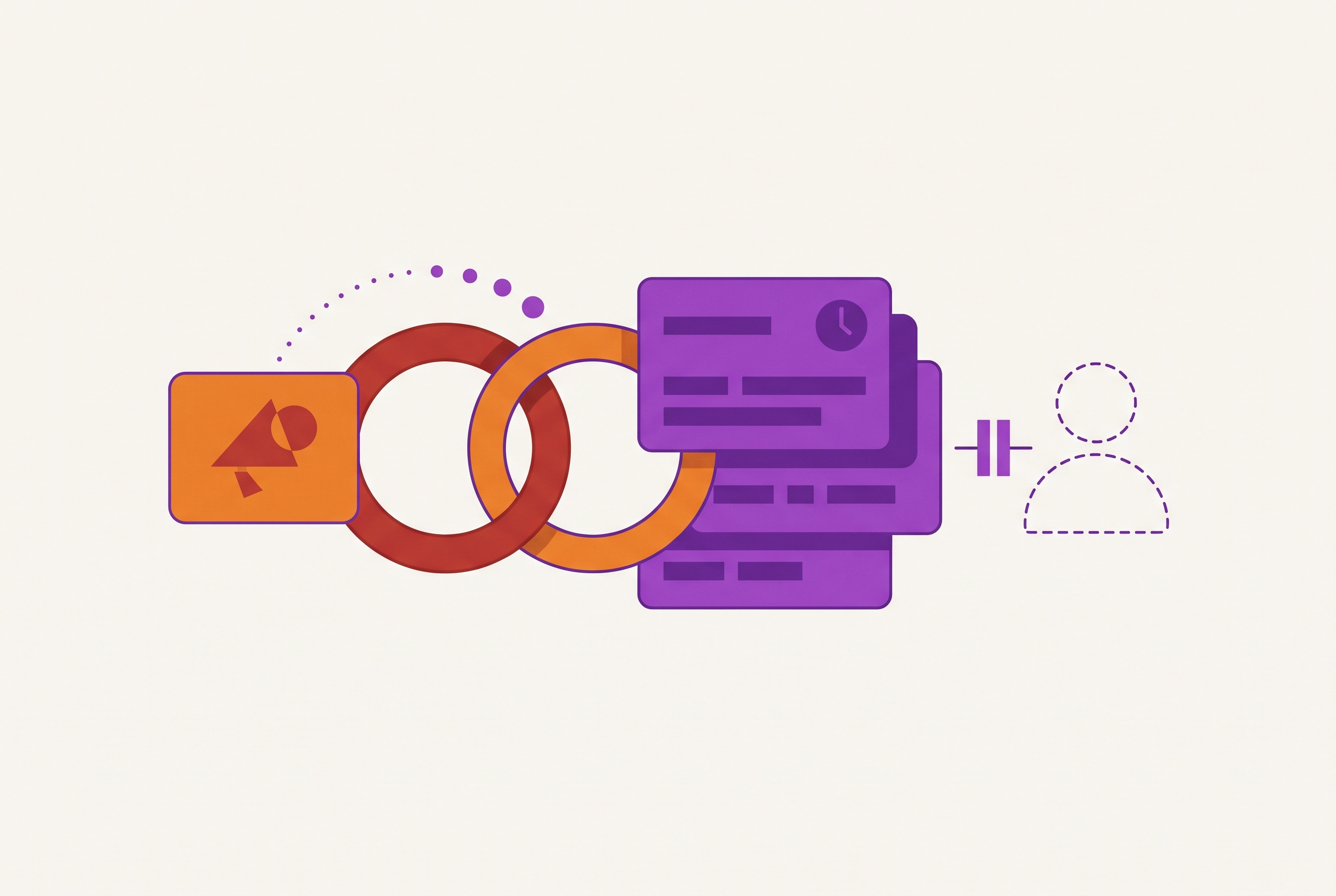
For an RB2B alternative, Albacross, Snitcher, ZoomInfo WebSights, and HubSpot Breeze Intelligence offer company-level identification, but not equivalent person-level outreach records. Teams seeking more than a LinkedIn profile need to distinguish identity enrichment from campaign attribution. The decisive capability is binding ad source to an identified session before contact creation, so paid media can be evaluated by whom it reaches.
Why the moment of identification is the critical attribution window
A paid click and a CRM contact record are separated by a gap that most visitors never cross. Most B2B visitors leave without submitting a form, so much of the traffic a company pays for never becomes a named record in its sales system. The visit still appears in channel reporting. Google Analytics 4 and ad platform dashboards show how traffic performs as a whole, but they do not link each session to a named prospect.
CRM-native attribution does not fully bridge that gap. HubSpot’s native attribution starts from the contact record and depends on interactions visible through its tracking code or integrations. Touchpoints outside that instrumented perimeter require additional configuration or can be missed. The limitation is structural rather than a verdict on CRM attribution. A campaign can bring a relevant buyer to the site, yet leave sales with no actionable connection between that buyer and the paid visit. If the visitor leaves without converting, the chance to link their identity to the source may be lost.
What visitor identification tools actually do at the session level
Visitor identification tools close this gap by resolving an anonymous session to a company or individual before a form submission or CRM record creation. When the visitor lands, the tool reads the UTM parameters attached to the ad, including campaign, source, and medium. It captures those values together with the identification signal. The resulting session record binds the source to the identified visitor rather than leaving it in an aggregate channel bucket. Identification and attribution become parts of the same record.
The identity returned depends on the matching mechanism. Reverse IP lookup maps a network to an organization, while an identity graph can connect a visitor signal to a named individual. A company match can establish which account arrived from a campaign, while a person match can establish who arrived. Tools also differ in how well they can report which campaign or source sent each visitor. Capturing a UTM string is only the beginning of that connection.
Company-level versus person-level identification: different outputs, different actions
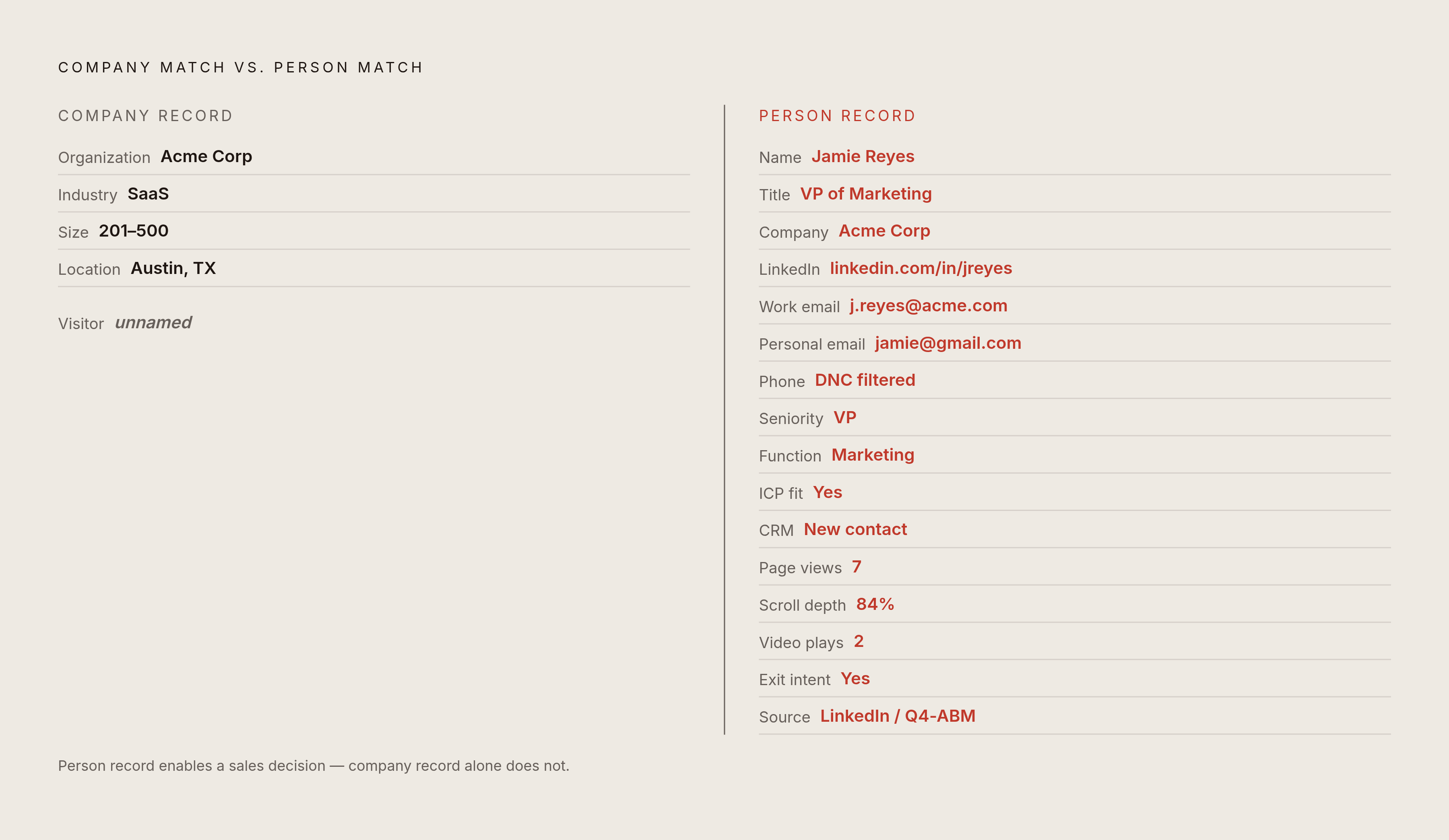
Company-level identification gives the name of an organization and firmographic details such as its industry, size, and location. That is enough to qualify an account. It is not enough to identify the employee who visited or provide a direct outreach route. Company matching generally covers a meaningfully larger share of B2B traffic than person matching, although remote work and VPN use weaken the connection between a visitor’s network and employer. A home connection may show no useful link to a company.
Organization-level firmographics generally fall outside GDPR personal data restrictions, but the IP address used to find them is personal data, so processing it needs a lawful basis. Company matching is therefore often the more practical option for EU and UK traffic, subject to privacy obligations. Person-level identification is still largely limited to US traffic. Its coverage depends on both the available identity signals and the applicable consent requirements.
An identity graph match can return a name, title, work email, and LinkedIn profile, but the visitor must already have a linkable signal in that graph. That signal can be a prior cookie, tracked email click, hashed email, or logged-in session. Person-level coverage is therefore much lower than company-level coverage. Buyers should press vendors claiming unusually high person-level match rates on whether their figures include company matches. For attribution, the distinction is precise. One record identifies the account a campaign reached, while the other identifies an individual sales can approach before a contact record exists.
What the enriched session record contains when person-level identification fires
A basic person-level match has a name, company, job title, and LinkedIn profile URL. It identifies someone without necessarily making them reachable. A more complete record adds company-domain-matched work email, personal email, a do-not-call-filtered phone number, classified seniority and job function, region, and an ICP fit flag. Those fields cut the research needed to go from identification to outreach.
CRM status is a crucial part of that record. Whether the visitor is already in CRM, still outside CRM, or an existing customer changes the appropriate response from new outreach to a sales alert or an expansion conversation. Behavior then gives that response context through page views, scroll depth, time on page, video plays, exit intent signals, and form copy events. The traffic source field connects the activity to the specific ad platform and campaign that prompted it. A LinkedIn profile sent to Slack is a notification. A person-level journey with contact details, CRM status, page activity, and campaign source is an input to a sales decision, provided those fields are available when identification occurs.
How AI agents and bots corrupt the session record if left unfiltered
The usefulness of that record depends on distinguishing human visits from automated traffic before identification feeds attribution. AI crawlers, traditional bots, and browser agents can all enter the session stream, and some agents behave like human visitors. Standard analytics do not reliably make that distinction visible. If automated traffic reaches the identification layer without filtering, a reverse IP lookup can resolve it to a cloud provider, research organization, or AI company. That organization can then appear as an identified account despite the absence of a human buyer.
The error spreads when source data accompanies the match. When a campaign gets credit for those visits, its attributed traffic is too high, and its engagement and cost-per-visit metrics no longer accurately show how people respond. Filtering after identification leaves the initial counts overstated. Edge-layer approaches use behavioral analysis and fingerprinting to block or flag bots before they enter the identification pipeline, while taxonomy-level approaches list known agents to help decide which to allow or block. AI agent detection can also reveal which content agents consume and who operates them. That is useful on its own, but sound attribution depends on keeping those sessions separate from the human visits used to judge how a campaign performs.
What are the alternatives to RB2B, and how do they bind ad source to sessions?
RB2B sends the results of person-level identification to Slack along with page-view data. Its pricing page, as of July 2026, lists a free company-level tier and paid monthly tiers for person-level identification. Campaign attribution is limited to the UTM parameters brought into the session, defining the comparison point for alternatives. A competing tool may have a different account database, different reporting tools, or a focus on a different region without adding more to the person-level record.
ZoomInfo WebSights uses reverse IP lookup against ZoomInfo’s company database. It is available only within MarketingOS and as an add-on with certain SalesOS tiers. Its output is company-level, which suits account qualification rather than direct identification of the individual visitor. Albacross also focuses on company identification, with an EU orientation and flat monthly plans. Its pricing page, as of July 2026, lists Starter at EUR 59/month, Professional at EUR 149/month, and Organisation as quote-based.
Snitcher has company tracking built into a web analytics platform with usage-based pricing. Its July 2026 pricing page lists several usage-based tiers, making usage rather than a flat monthly plan the pricing distinction. Clearbit Reveal, now HubSpot Breeze Intelligence, fits existing HubSpot Pro/Enterprise customers who do not need person-level data. HubSpot acquired Clearbit in December 2023, and all Clearbit free tools were sunset April 30, 2025.
Koala is no longer an available alternative. Cursor acqui-hired its team in July 2025, and the product shut down completely on September 30, 2025. Koala pointed customers toward Common Room and gave them time to export data before shutdown, but afterward they could no longer migrate or export their data. That history makes vendor durability a separate selection criterion from identification depth. Across available tools, the attribution distinction remains whether the output is a company with a UTM string or a named person with campaign source and a full page journey. More account data does not, by itself, mean more actionable person-level attribution.
CRM and ad platform integrations that let teams act on the session record before it becomes a contact
Teams can act on pre-contact attribution when the identified session reaches the systems they already use without a manual export. Native integrations with HubSpot, Salesforce, or Attio can create or update a record with the ad source populated at identification. The contact record becomes an output of the session. For an existing prospect, the same flow can add context to the record already in use instead of treating every identified visit as a new lead. Integration depth varies, however, and Salesforce access can be restricted to enterprise tiers.
Slack and Teams alerts serve a different purpose. They can deliver the person’s name, company, pages viewed, and ad source while the visitor is still on the site, giving a rep context for outreach during the same session. Ad platform integrations with Google, Meta, and LinkedIn can instead add the companies and people identified to retargeting audiences. The next impression can then reflect what the visitor viewed without waiting for a form submission to start the audience workflow.
Event-driven webhooks take that flow into internal tools, n8n automations, and outreach sequences. HMAC-signed delivery on person.identified and person.activity events provides a route beyond native connectors. REST APIs and bulk CSV exports also let teams use session data in custom CRM objects, warehouses, or BI tools, although a manual export does not provide the same immediate response. MCP-based access can make session data available to AI-assisted prospecting where the relevant connector exists. For agencies, separate scoped API keys for each client domain allow the same workflow across a portfolio without mixing client data.
Why pre-contact attribution changes how paid media spend is evaluated and allocated
Binding source to an identified session changes the question paid media reporting can answer. Conversion reporting asks which channels produced form fills or demo requests, while session-level identification asks which channels reached the companies and people the team wants in its pipeline. Those answers can diverge sharply. A campaign that brings named people from target accounts to a pricing page produces evidence of relevant engagement even when none submits a form. That evidence is a signal that conversion-only reporting leaves out.
A LinkedIn campaign with few clicks and no conversions may therefore show useful target-account visit patterns in its session records. Cutting it on conversion data alone could remove a productive top-of-funnel channel. The reverse is equally possible. A campaign with strong click-through rates may bring in mostly companies outside the ICP, showing that spend which looked efficient as a whole reached the wrong audience. Closing the loop still means sending closed-won data back to ad platforms, which native CRM attribution does not automatically do for every channel.
The strongest objection is that person-level identification covers only a fraction of sessions. That limits individual outreach, but not account-level evaluation. Company identification alone can show whether named target accounts are responding to a campaign, making person-level data an additional outreach layer. Unidentified spend is not necessarily wasted, and identified visits do not prove revenue. The budget decision is nevertheless better grounded when teams can distinguish campaigns that reach intended accounts from campaigns that merely generate activity. Pre-contact attribution supplies that distinction before form conversions become the only evidence available for allocating spend.
Notes
- We Tested 8 Website Visitor Identification Tools. Here's What Actually Worked.
Informed the comparison of visitor identification tools, including RB2B alternatives and the difference between company-level and person-level output.
Every new piece from Opt Out Report, as it's published.
FollowMore from Opt Out Report
- Anonymous Visitor Identification Tools That Name a Person Without Locking You Into One CRM8 min read →
- Person-Level Visitor Tools Ranked by How Much of the Session Survives Into the Contact Record9 min read →
- What Privacy-Conscious Buyers Lose When Their Visitor Tool Only Drops a LinkedIn URL Into Slack9 min read →