The Right Telemetry Stack for Isolating AI Agent Traffic Without Discarding the Intelligence Inside It
Classify AI traffic by origin and intent to keep buyer signals.
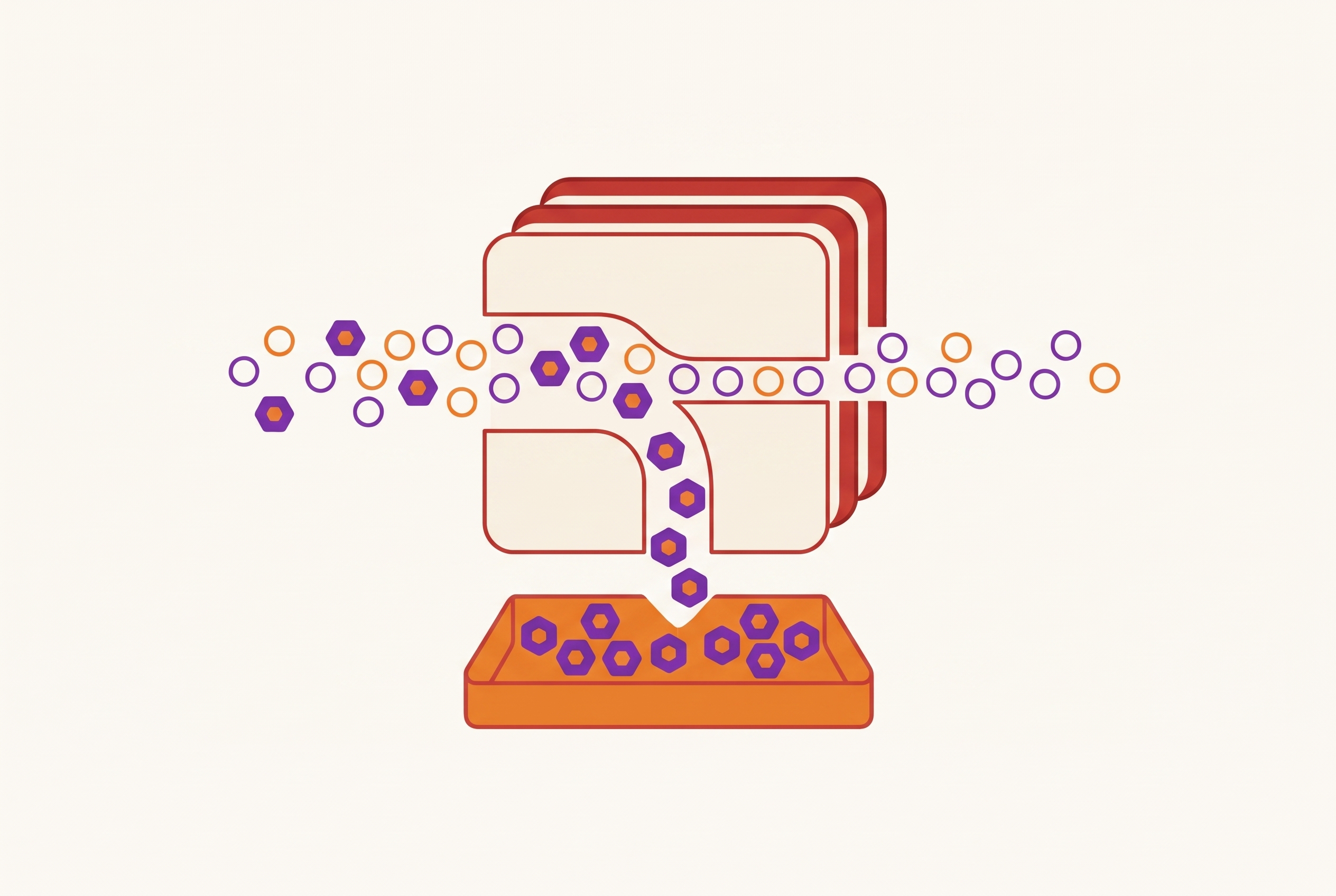
To detect AI agents on a website, use server logs and vendor IP verification along with edge-level fingerprinting and browser behavioral signals before sessions go into analytics or enrichment. The right telemetry stack separates training crawlers, search crawlers, user-triggered fetchers, and agentic browsers. That classification blocks disposable noise without discarding the buyer intent behind human-initiated AI visits.
Why AI agent traffic demands classification before any other action
A website can receive an automated request to collect training material and another request because a buyer has just asked an AI assistant to research a product. Both arrive as non-human traffic. But only the second is an immediate human intent event. A blanket bot policy treats these requests alike, either admitting noise into downstream systems or discarding intelligence that could have been recovered.
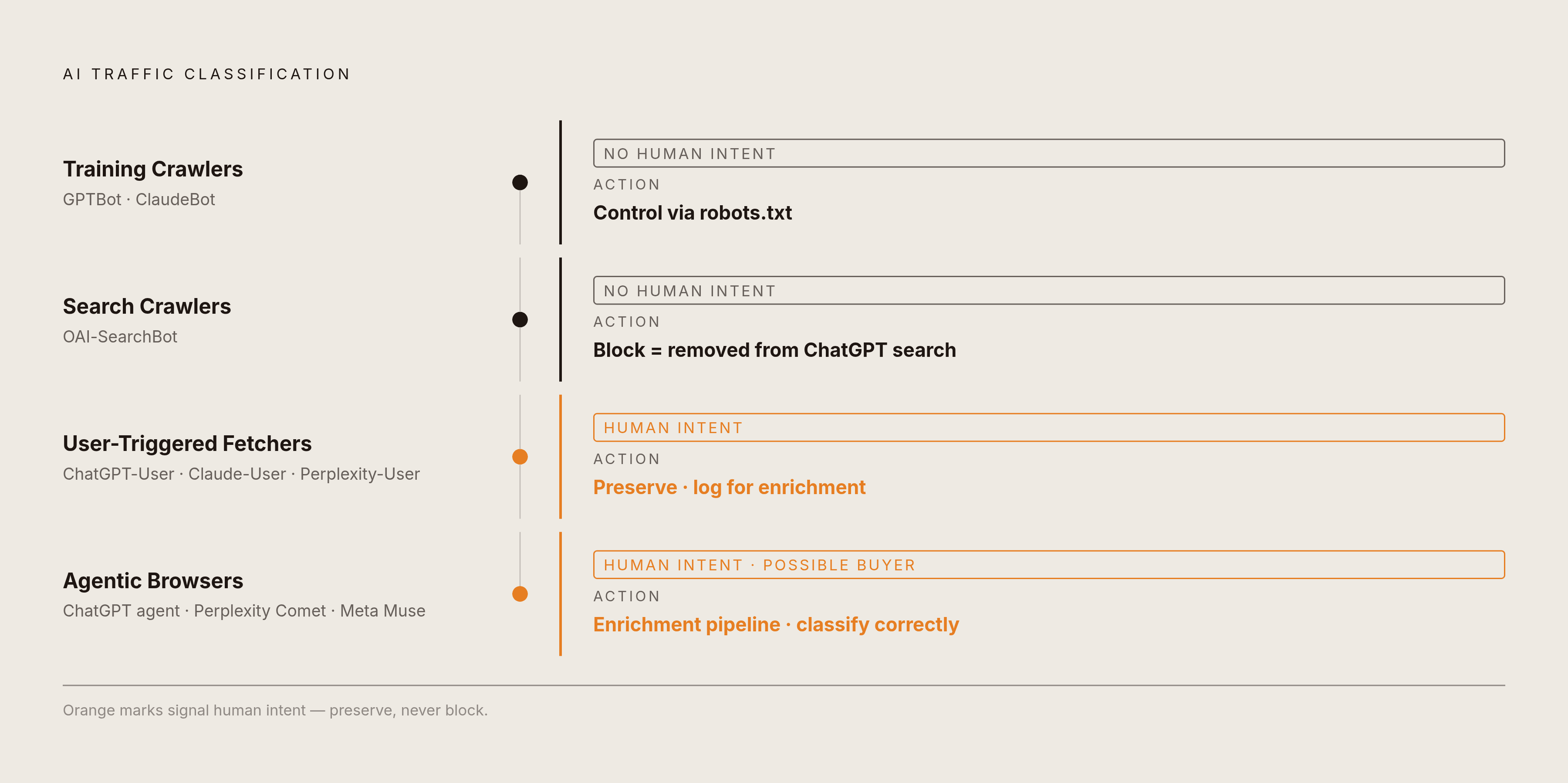
The distinction begins with four categories. Training crawlers such as GPTBot and ClaudeBot collect content on their own schedule, without a person initiating each request. Search crawlers such as OAI-SearchBot support discovery in AI search. Neither category provides a human identity to harvest from the crawl itself.
User-triggered fetchers, including ChatGPT-User, Claude-User, and Perplexity-User, visit because a specific person has asked a question that requires a page. Agentic browsers go further by driving a real browser to complete a task for someone. Examples include ChatGPT agent running in OpenAI’s cloud, Perplexity Comet with its browser client on the user’s machine and AI routed through Perplexity’s cloud, and Meta Muse. These are not interchangeable with background crawlers. Their requests may contain evidence of product research, making classification a prerequisite to deciding what to retain.
Why standard analytics tools see only part of this traffic, and misread the rest
Conventional analytics loses visibility at the point where a request does not execute JavaScript. Training and search crawlers request raw HTML without firing the analytics tag, so GA4, PostHog, and Amplitude record zero visits from them no matter how much they crawl. User-triggered fetchers bypass the same layer. A ChatGPT-User fetch therefore looks like a training crawl from the analytics system’s perspective, even though a person prompted it. Neither appears in the session data.
Agentic browsers create the opposite failure in measurement. They operate in real browsers, execute JavaScript, and generate session data that looks human. GA4 counts those sessions as real users, inflating session counts and distorting attribution. Visitor identification systems can then attach names and companies to autonomous scrapes through false-positive enrichment matches.
The resulting gap runs in both directions. An analytics report cannot explain which content invisible crawlers requested, and a plausible browser session does not establish that a human directly visited. Correcting only the missing crawler count leaves the false human sessions intact. Both problems require classification upstream of analytics, where request evidence and browser evidence can inform how a session is recorded.
The spoofing problem that makes user-agent strings an unreliable starting point
A user-agent string says who made a request but does not prove the claim. Prosopo’s log analysis found that more than half of requests carrying an AI user-agent string were spoofed. Between 5 and 18 October 2026 on prosopo.io, every request presenting an xAI, Cohere, Mistral, or Google-Extended user-agent came from a spoofer. Most impostors in that sample originated from Google Cloud infrastructure. Those findings apply specifically to the sample.
Google-Extended provides a particularly clear test of the declaration. Google states that it has no user-agent of its own, so a request presenting that name is fake by definition. Prosopo’s second sample, which covered requests with AI user-agents from 15 October to 11 November 2026, showed much the same thing. Some AI names had no genuine traffic across that entire period. A familiar label was not evidence of origin.
The operational consequence extends beyond allowing spoofed scrapers through. Blocking every request with an AI name also rejects legitimate user-triggered fetchers, discarding the human intent behind them. User-agent matching is therefore useful for locating candidate requests in logs, but insufficient for assigning a trusted category. The next step is active verification. A classification system must check whether the request’s identity, network, browser environment, and behavior match what it claims to be.
The four signal layers that make classification reliable
Identity signals test the request’s technical consistency through HTTP headers and TLS fingerprints. Header checks can reveal deviations from genuine browsers’ ordering or capitalization patterns that weaken the claimed identity. However, a plausible handshake and header set cannot establish who initiated the request.
Network signals use ASN checks and IP reputation to help show where a request came from. Data center ASNs associated with AWS, GCP, or Azure are strong automation indicators, while a Meta crawler user-agent from AS32934 is a meaningful positive signal. The same declaration from a residential ISP is suspicious. Vendor-published IP ranges provide the strongest positive network verification available. OpenAI publishes ranges for GPTBot, OAI-SearchBot, and ChatGPT-User, while Anthropic, Perplexity, and DuckDuckGo also publish crawler ranges. Meta publishes no crawler IP range file, so the right check is whether the request comes from AS32934.
Cloud-hosted agentic browsers can expose Chrome DevTools Protocol artifacts, abnormal or missing viewport properties, and browser API inconsistencies. Comet on a user’s machine presents a harder case because its ordinary Chrome user-agent and network fingerprint do not distinguish it from a human. JavaScript-observable evidence becomes necessary at that point.
Behavioral signals examine interaction patterns. Deterministic mouse paths, DOM burst reads, no viewport scroll before the first query, and absent keystroke variation can expose automation even when other signals look clean. A 0–100 session score supports graduated responses. Where available, cryptographic verification adds stronger proof than heuristics. ChatGPT agent supports HTTP Message Signatures through a Signature-Agent header and published verification keys, making that path the gold standard for verifying its origin.
What correct classification unlocks: treating each category according to what it actually is
A content licensing policy should set the rules for verified training crawlers. They provide no buyer-intent signal, so allowing or blocking them does not require an enrichment decision. Robots.txt remains the appropriate control surface for verified crawlers. Search crawlers require a separate strategic judgment because blocking OAI-SearchBot removes the site from ChatGPT search results.
User-triggered fetchers warrant preservation. A ChatGPT-User or Claude-User request indicates that a person asked a question that surfaced the site, although the request does not itself reveal that person’s identity. OpenAI and Perplexity state that robots.txt rules may not apply because a person initiated the fetch. The record should have the agent identity, page fetched, timestamp, and referring AI platform. Together, these fields describe an intent event for downstream enrichment.
Agentic browsers require a distinction between automation and purpose. A cloud-hosted browser researching a product for a buyer can represent intent of the same quality as a human session and should enter the enrichment pipeline as such. It should not be mislabeled as direct human browsing. For on-device browsers such as Comet, behavioral scoring provides the triage that vendor IP verification cannot. A high automation score on an apparently ordinary Chrome session is a reason to flag it, even when the underlying task has human value.
Extracting buyer-intent intelligence from user-triggered and agentic sessions
Classification establishes the type of visit. Person-level identification still requires a prior identity graph event, such as a tracked email click, known cookie, hashed email match, or logged-in session. The same constraint applies to human visits. Without that connection, a user-triggered fetch remains evidence of intent. Classification prevents a false identity from being attached to an autonomous scrape, but cannot create an identity that the available evidence does not support.
When identity conditions are met, the preserved intent event can become a person-level record. The AI platform, fetched page, and timestamp can connect to a name, work email, LinkedIn URL, job title, and company. The full page-view and event journey adds context where that activity is captured. A raw-HTML fetch on its own has no browser interactions. Enrichment must preserve that distinction rather than treating every AI-originated request as a complete browser session.
An integrated intelligence layer joins those records with page views, scroll depth, exit intent, CRM status, and ICP flags. The traffic-source field that records Google, Meta, or LinkedIn for an ad-driven visitor can also record ChatGPT, Claude, or Perplexity for an AI-surfaced session. AI agent detection then governs how the record enters attribution, while the event journey describes the available activity.
Paid-media attribution benefits from separating agentic sessions from direct human sessions. Company and person matches in the human pool are no longer diluted by autonomous scrapes sharing a similar session fingerprint. The human-initiated AI activity that was kept can still go into enrichment with its correct classification. Cleaner attribution does not require discarding that intent.
Company-level identification covers a meaningful share of US B2B sessions, while person-level identification covers a much smaller share. A vendor figure that mixes human sessions with bot and agent sessions obscures what the system can actually identify. Unresolvable non-human records must not be presented as evidence of person-level reach.
How to detect AI agents on a website with a practical telemetry stack
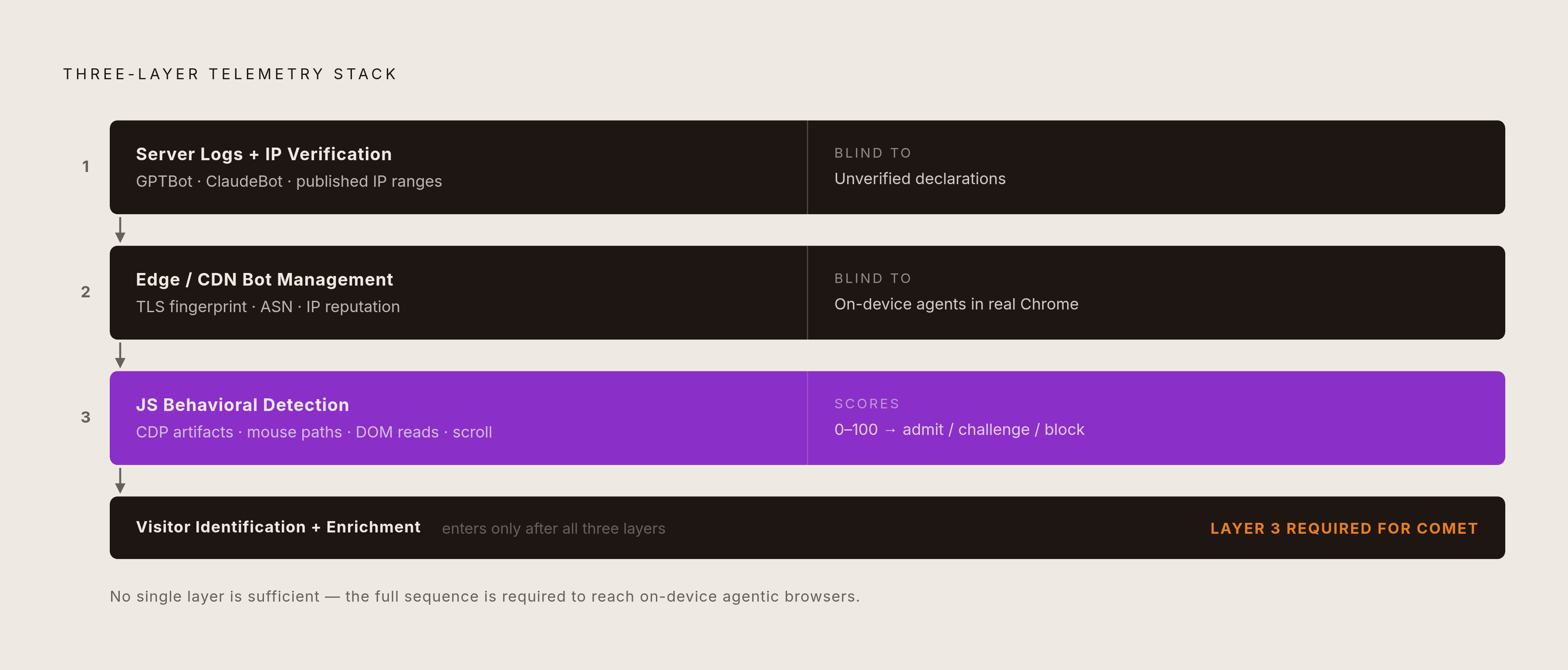
Search access logs for known strings such as GPTBot, ClaudeBot, ChatGPT-User, and Claude-User, then compare source IPs with the relevant published ranges. The pages those verified agents request show which content they are reading. Meta requires the AS32934 check. Range data also needs regular refreshes because files can be regenerated without notice. This first layer is best for self-declaring crawlers.
Edge/CDN bot management supplies the second layer at request time. TLS fingerprinting, ASN checks, and IP reputation let rules distinguish verified crawlers from unverified declarations without changing application logic. A policy can allow GPTBot while challenging an unverified AI user-agent. This layer is best suited to request-level verification and cloud-origin signals. It cannot reliably distinguish an agentic browser on a user’s machine from a human using Chrome.
JavaScript-layer behavioral detection can help tell these browsers apart. Environment checks and interaction scoring expose evidence such as CDP artifacts, deterministic mouse paths, DOM burst reads, and missing viewport scroll. For sessions without verified human-initiated intent, graduated handling can admit low-score sessions to enrichment, challenge mid-score sessions, and block high-score sessions. Verified user-triggered and cloud-agentic intent needs a separate route that keeps it.
Visitor identification and enrichment belong after these decisions. What goes in is filtered human sessions plus the user-triggered and cloud-agentic sessions that were kept and classified as human-initiated intent. Person-level enrichment, journey capture, and CRM-status checks can then operate without treating every automated visit as a human buyer. AI platform and ad platform are still named as traffic sources. Webhook and API delivery through person.identified and person.activity events routes actionable records into Slack, HubSpot, Salesforce, or existing downstream tools.
The practical procurement test follows from that order. Before comparing identification rates, a team should ask whether each vendor’s reported match rate excludes bot and agent sessions.
Notes
- How to detect AI crawlers
Covers detecting AI crawlers through logs, user-agent strings and IP verification, the groundwork for the article's first detection layer.
Every new piece from Opt Out Report, as it's published.
Follow