The Opt-Out Principle Applied to AI Assistants Prospecting Your Site Without Disclosure
Opt-out tools govern content use, not whether a visitor gets identified.

To detect AI agents on a website, operators need to distinguish agent traffic from human visits and identify which content agents consume. Bot management governs access, while person-level visitor intelligence can resolve identifiable sessions to people. This distinction defines the opt-out gap for AI assistants browsing without disclosure. Content-use controls do not prevent a site from identifying the person behind a visit.
What actually happens when an AI assistant browses on a user's behalf
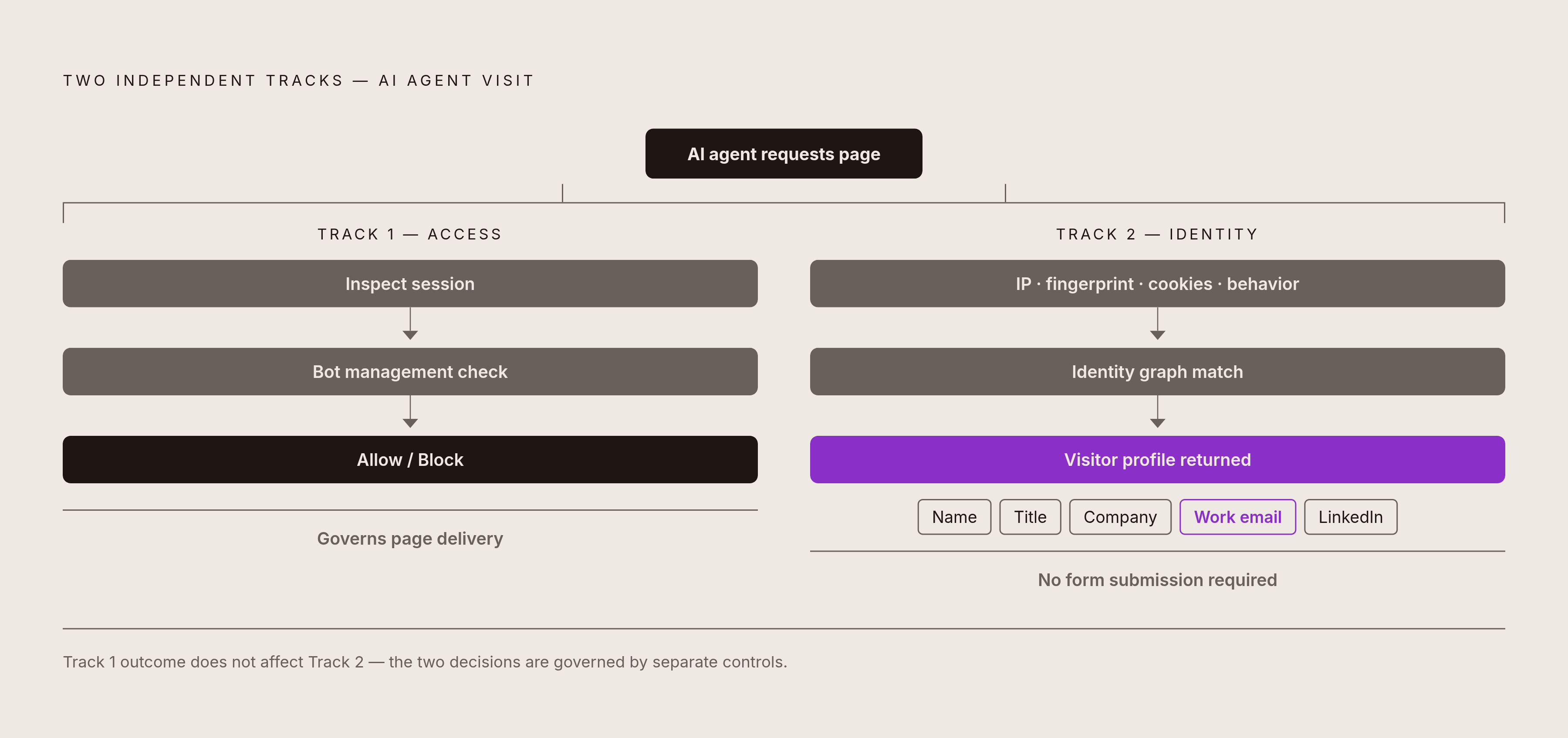
A procurement officer instructs an assistant to research a vendor’s pricing page. The assistant visits the site to complete that task, while the vendor’s infrastructure receives a session it can inspect. Two processes can now run in parallel. The site can decide whether to admit the agent, and its visitor-identification infrastructure can attempt to match the session to a person. The assistant does not disclose that site-side enrichment to the user.
The distinction begins with the kind of traffic involved. Training crawlers collect content for model training, while retrieval traffic fetches content to use for a task. User-triggered fetchers, including ChatGPT-User, Claude-User, Perplexity-User, and Google-Agent, visit because a particular person requested a task. AI referrals are another category, distinct from an agent fetching a page itself. Undeclared or masquerading traffic presents a separate detection problem because it does not identify itself reliably.
Cloudflare accused Perplexity of disguising crawlers to reach sites that had blocked it, a charge Perplexity denied. Declared fetchers pose a different question. Where a user-directed session exposes IP signals, device context, and behavioral fingerprints that an identity system can match, the site can attempt enrichment. Permission to retrieve the page and the ability to identify the session are separate decisions.
How person-level visitor identification resolves an anonymous session to a named individual
Person-level identification checks signals from a device that visits the site for a match in an identity graph. Those signals include IP address, device fingerprint, cookies, and behavioral patterns. Publisher networks link devices, hashed emails, and browsing profiles into the graphs used for matching. A successful match can return a name, title, company, LinkedIn URL, and work email without a form submission. The form is not the point of disclosure.
Reverse IP lookup might show that someone from Microsoft visited, without showing which employee it was. Person-level tools such as Avina, RB2B, and Warmly attempt the more specific match. Leadpipe sends an identified visitor’s identity details through a webhook, along with the page they viewed and how long the visit lasted. For an AI-assisted visit, the relevant condition is whether the available session signals can be matched.
Match rates remain contested. The realistic person-level range cited in the notes is 5–20% of US visitors, with company-level identification substantially higher. Vendors can report much higher headline rates by defining “eligible” traffic narrowly and calculating against a denominator buyers cannot see. Bots represent a majority of web traffic, so including or excluding them can roughly double or halve the apparent rate before matching performance enters the calculation. Even the conservative range represents meaningful exposure, but it does not establish that every user-triggered fetch identifies its requester.
Where the enriched identity goes after the visit
The procurement officer’s exposure does not end when a name appears in a dashboard. An enriched record can flow into CRM systems, advertising audiences, and outreach sequences on its own. The researcher may then be routed to a sales representative, retargeted across advertising platforms, or enrolled in automated outreach within hours. None of that requires another visit from the researcher. The commercial workflow can proceed without their awareness.
Leadinfo integrates with more than 70 platforms, including HubSpot, Salesforce, and Pipedrive. Its integrations can create identified companies as leads and transfer behavioral data and ICP scores into CRM records. HubSpot and Salesforce also support advertising audience syncing, allowing contact lists sourced from visitor identification to become retargeting audiences across LinkedIn, Meta, and Google. A company lead is not proof that a particular employee was resolved.
Acquisitions are bringing enrichment and conversion closer to the CRM. HubSpot agreed to acquire Warmly on 30 June 2026. Warmly sends visitors through multiple data providers in a waterfall approach, and what visitors do on the site triggers real-time chat engagement and automated outreach. Salesforce completed its acquisition of Qualified on April 1, 2026, and is integrating its agentic marketing expertise into Agentforce.
The opt-out infrastructure that exists and what it actually covers
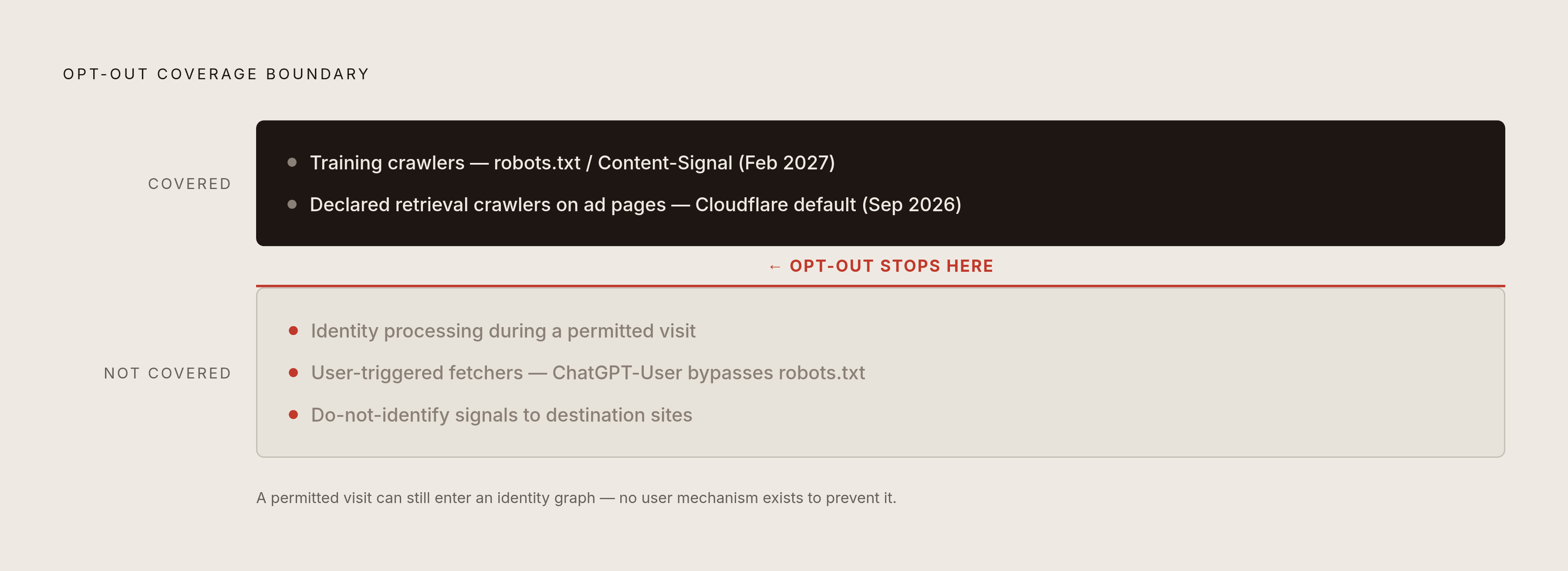
Shared robots.txt tokens state how a site wants its content used, while CDN policies can enforce rules on who gets access. These controls serve a legitimate, bounded purpose. Microsoft states explicitly, “These settings govern use of content, not crawl access”. A crawler can therefore reach a site even where the site has expressed a preference against a particular use of its content. Neither that preference nor an access decision specifies how the site should process visitor identity.
The shared token covers training, defined as “using an asset to modify the learned parameters of a generative AI model”. Ranking models trained on pages fall outside that definition, and OpenAI’s reference to “foundational generative AI training” may narrow it further. Microsoft’s support takes effect 1 February 2027, while Google’s is targeted for early 2027. Smaller labs, open-source projects, and data brokers have not promised to support it. The draft also says a wildcard user-agent group must not be interpreted as matching the policy token, so an existing block-all rule expresses no preference under this mechanism.
User-triggered fetching introduces another boundary. OpenAI’s documentation states that robots.txt rules “may not apply” to ChatGPT-User because a user initiates the request. Cloudflare’s September 15, 2026 default change blocks training and agent use on pages with ads for new customers and new websites. Its Personal Assistants category, added November 4, 2026, allows site-wide permission, blocking only on pages with ads, or blocking across the entire site. Google’s AI optimization guide says to ignore tactics such as llms.txt for AI search.
How widely the opt-out tools have actually been adopted, and what that reveals about the gap
Only a small share of sites publish Cloudflare’s Content-Signal directive, which adds a structured machine-readable signal beyond basic robots.txt entries. Sites that block crawlers tend to use copied lists that exclude nearly all of them together. The choice is often to block all crawlers or let them all through. Few configurations distinguish training from retrieval and user-triggered fetching. This limits the practical precision of controls that could otherwise express different policies for different uses.
Publication is also different from enforcement. Robots.txt is a request. Major AI operators say their declared crawlers follow it, but bot-management infrastructure enforces the rules. HasData’s September 2026 measurement found that a substantial share of sites disallowing GPTBot still served the crawler a live page.
These findings concern content access and use. They do not measure how often an AI-assisted visitor is identified, and they should not be presented as doing so. Even a perfectly observed training opt-out would not tell a procurement officer whether a permitted visit entered an identity graph. The two gaps compound each other.
The legal asymmetry between opt-out and prior-consent regimes
GDPR Article 6 requires a lawful basis before personal data is processed. Legitimate interest under Article 6(1)(f) is a common claim for visitor identification, but Recital 47 requires balancing against the data subject’s rights. The ePrivacy Directive separately requires consent for tracking cookies. Prior lawful basis and prior consent are not interchangeable concepts.
CCPA and its successors place greater emphasis on opt-out rights. In that model, enrichment, CRM entry, and retargeting can occur before a person exercises an objection. That distinction changes the sequence of exposure. As of January 2026, Kentucky, Rhode Island, and Indiana had enacted privacy laws requiring clear opt-out mechanisms for targeted advertising. Those requirements add to the state-level patchwork without resolving how an objection is enforced throughout downstream CRM workflows.
Recording a preference is not the same as honoring it. Salesforce’s documentation says its preference fields “simply help you track your customers’ requests” and leaves the company responsible for determining how to honor them. Meanwhile, the person directing an AI assistant has no mechanism to send a do-not-identify preference to the destination site.
What the exposure looks like from the site operator's side — and why it is a feature, not a flaw
For the operator, an AI-assisted pricing-page visit can represent genuine buying intent. A procurement officer asking an assistant to compare features is conducting research, just as someone visiting directly would be. Most B2B visitors leave anonymously without converting. Person-level identification turns some of that traffic into potential pipeline, which gives operators a business reason to retain identifiable AI-assisted research sessions.
Person-level visitor intelligence can combine name, title, company, LinkedIn profile, business email, and a do-not-call-filtered phone number with classified seniority and job function. It can also include visit count, an ICP hot-lead flag, CRM status, and traffic source. The event journey can cover page views, clicks, scroll depth, video plays, exit intent, and form submissions. A LinkedIn profile delivered to Slack is an alert, while an identified journey gives a sales team a basis for deciding whether and how to act.
Identified visitors can also feed advertising platforms with signals that help optimize toward qualified accounts, including accounts conducting AI-assisted research. Even conservative matching can yield a commercially meaningful cohort on a mid-size B2B site with sufficient research traffic. Researchers lack visibility into whether their sessions are identified. Calling the process a feature explains why a business wants it, without settling whether a given use is lawful or acceptable.
What operators and AI-assistant users each need to understand and do
For operators, the practical distinction is between detecting an agent and resolving a person. Agent detection identifies traffic such as ChatGPT-User and Claude-User, the content consumed, and the operator behind the agent. Human visitor identification tries to find out who a person is from the identity signals it has. These are complementary capabilities. Detecting Claude-User does not, on its own, establish who instructed the assistant to visit.
The lesson for buyers is to examine both capabilities and their denominators. Operators should ask vendors how match rates are defined and whether bot traffic is excluded before the rate is calculated. Separating AI agents and other bots from human sessions produces a cleaner measure of identification performance and a more accurate pipeline. Visitor intelligence should also be available through APIs, webhooks, and MCP connectors alongside a dashboard. Those interfaces let teams use the intelligence in sales, demand-generation, and CRM workflows through the tools and AI agents they already use.
For assistant users, the limit is equally concrete. The opt-out infrastructure announced in October 2026 addresses training use of content. The shared token reduces the maintenance burden of expressing preferences to multiple training crawlers, and CDN controls can distinguish personal assistants from training traffic. Neither provides a do-not-identify instruction for a permitted visit. Content-use signals and bot management govern the content-access layer, while visitor intelligence with separate agent detection governs the operator’s view of the identity layer. Two layers require two instruments, and neither should be mistaken for the other.
Every new piece from Opt Out Report, as it's published.
Follow